

By HRH Princess Eugene Majuru – Princess of Harare & Sovereign Heritage Custodian
In a recent public warning issued to Wicknell Chivhayo, former legislator Temba Mliswa made a profound statement regarding governance and authority in Zimbabwe. While his confrontation addresses contemporary disputes, it is his commentary on our ancestral governance structures that requires immediate, uncompromising correction.
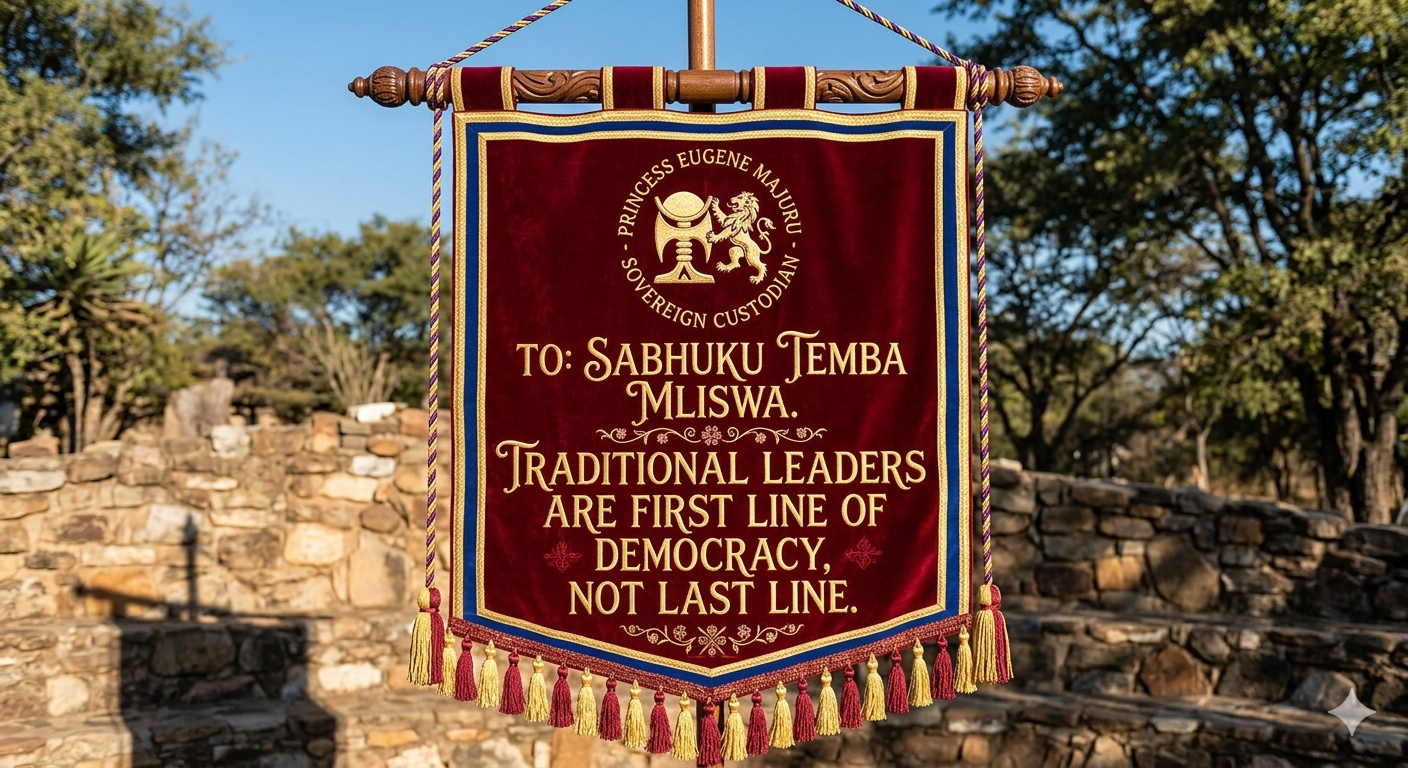
Mliswa in a video shared across social media asserted that traditional leaders stand as the “last line of democracy.” He further remarked that Masabhuku (village heads) represent the people. While it is true that Masabhuku are structural pillars for the community, Mliswa is entirely wrong to relegate traditional leadership to the “last line” of anything.
To call indigenous rulers the last line of democracy reveals a deeply colonized mindset that remains trapped in the administrative framework imposed by British colonialists.
Deconstructing the Colonial Erasure of African Royalty
We must look honestly at historical facts. Traditional leaders were only made to look like a “last line” or a symbolic afterthought because British colonialists systematically sought to dismantle African royalty. When the British colonizers invaded Zimbabwe, they imposed foreign laws specifically designed to suppress indigenous sovereign systems.
They stripped supreme kings and royal houses of their absolute governing authority, rewriting their titles to make them appear secondary, ceremonial, or useless. This was a deliberate strategy to break the backbone of African self-governance and replace it with a system where indigenous authorities answered to a colonial magistrate.
When modern politicians echo these sentiments, they are accepting the subjugation of their own heritage. To believe that Western-introduced political systems sit at the top while indigenous rulers sit at the bottom is to remain mentally colonized to this very day.
The True Hierarchy: First Line, Not the Last
Let the record be corrected from the perspective of our deep-rooted heritage: Traditional leaders are not the last line of democracy; they are the first line of governance.
Before there was a parliament, a prime minister, or a cabinet minister, there were the Kings, Sovereigns, and traditional custodians who governed the land with structured, unbroken systems of justice, spiritual alignment, and community welfare. If Mliswa understands the role of a Sabhuku well enough to invoke it, he should also understand the true, uncorrupted hierarchy of traditional leadership.
The Hierarchy Prevails: True traditional leaders and sovereign custodians sit above ministers and political appointees. Political positions are transient, shifting with election cycles and partisan interests. Traditional and royal custodianship, however, is permanent, tied directly to the soil, the people, and the ancestors.
The Grassroots Reality: Masabhuku, headmen, and chiefs are the immediate, daily contact point for the majority of our people. They manage community disputes, preserve social cohesion, and protect local ecosystems long before a central government official ever sets foot in a village. They are the foundational line of authority.
A Call for True Decolonisation
Zimbabwe’s independence cannot merely be a matter of changing flags and political faces; it requires a radical decolonization of our governance mindset.
The ongoing suppression and marginalization of African royalty—treating kingship as an ancient relic rather than a living, superior structure of governance—is a lingering scar of the British occupation that Zimbabwe must urgently correct.
As the Princess of Harare and the Sovereign Custodian of the Mbari Royal House, I urge Mliswa and all public figures to educate themselves on the authentic hierarchy of our land. Stop measuring the value of African royalty through the distorted lens of colonial legislation. It is time to shake off the remnants of British conditioning, respect the true authority of indigenous institutions, and recognize traditional leaders as the foundational first line of our nation’s sovereignty. Traditional leaders are custodians of the land, political leaders like Ministers come and go.
#Thembamliswa #sabhuku #africanroyalty #hararembarisovereigncustodian #highlight #decolonisation
Comments
About Author