

By HRH Princess Eugene Majuru
Cultural Heritage Sovereign Custodian, Sovereign Heritage Advocate & Cultural Historian
Across the length and breadth of Zimbabwe—from the historic suburbs of Harare to regional municipalities and peri-urban hubs—heavy machinery roars in a relentless, unforgiving campaign. Brick by brick, small businesses, shopping centers, informal markets, and family homes are crushed into mountain piles of rubble.
The state narrative accompanying these actions is well-rehearsed: authorities claim to be restoring spatial order, enforcing urban planning laws, and cracking down on the scourge of politically connected “land barons” who unlawfully parcel out public, agricultural, and wetland plots.
Yet, as the dust settles over flattened settlements in Budiriro, Epworth, Mbare, and beyond, a glaring moral and systemic injustice comes into stark focus: If the stated objective is to punish land barons, why is the full brunt of state violence and destruction visited exclusively upon their victims?
Victimized Twice: The Cruel Mathematics of Displacement
The reality confronting ordinary Zimbabweans is a paradox of systemic cruelty. First, hard-working citizens—faced with an acute deficit of formal housing and a stagnant formal job market—turn to local housing trusts, cooperatives, and community leaders to secure a plot of land or build a modest shopfront. They pay life savings, monthly subscriptions, and council-adjacent levies, often shown documents bearing official stamps, promises of future regularisation, or political guarantees. They are victims of sophisticated fraud, deceit, and exploitation by land barons who capitalize on grassroots desperation.
Then comes the second wave of victimization—this time at the hands of the state and local authorities. Armed with court orders, municipal graders arrive with short or zero notice. They do not ask who collected the money; they do not trace the illicit bank transfers or seize the assets of the swindlers; they simply destroy the property of the victims.
┌──────────────────────────────────────────────┐
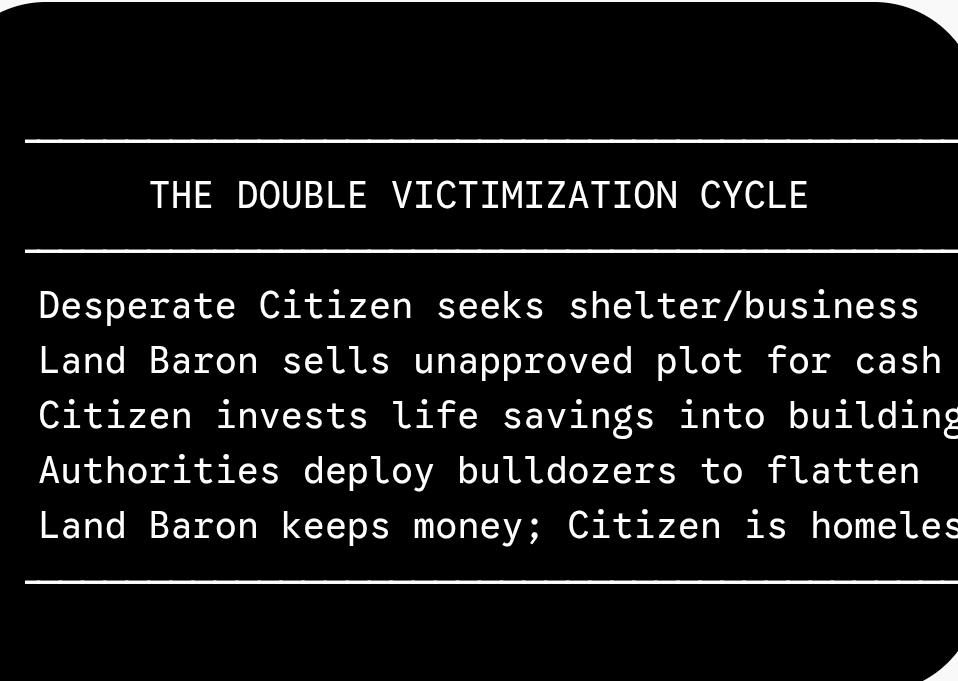
│ THE DOUBLE VICTIMIZATION CYCLE │
├──────────────────────────────────────────────┤
│ 1. Desperate Citizen seeks shelter/business │
│ 2. Land Baron sells unapproved plot for cash │
│ 3. Citizen invests life savings into building│
│ 4. Authorities deploy bulldozers to flatten │
│ 5. Land Baron keeps money; Citizen is homeless│
└──────────────────────────────────────────────┘
The land baron retains the thousands of dollars collected in illicit sales, often investing those proceeds in secure formal real estate or fleeing accountability. The citizen, meanwhile, is left on the roadside with broken furniture, destroyed stock, mounting debt, and no shelter.
The Human Emergency: Children, Women, and the Vulnerable
To reduce this crisis to a mere technical exercise in urban spatial compliance is a failure of leadership and basic human empathy. Behind every demolished tuckshop or home is a human story being needlessly shattered:
Children & Education: When homes are razed and informal family businesses collapse overnight, children are thrust into severe instability. School fees go unpaid, learning materials are lost under the rubble, and basic safety vanishes.
Women & Expectant Mothers: Women constitute the vast majority of informal traders and market operators. Destroying their workplaces removes their economic independence and directly threatens maternal and family health.
Psychological Trauma & Mental Health: The sudden loss of everything one has worked decades to build causes overwhelming psychological distress. Anxiety, depression, and hopelessness are sweeping through displaced communities without a single emergency shelter or mental health response unit in sight.
The Elderly & Chronically Ill: Senior citizens who rely on small rentals or informal trade to purchase life-saving medications are rendered completely destitute.
Historical Echoes: Colonial Governance vs. Cultural Ethics
As a Cultural Historian and Sovereign Custodian of our traditional heritage, I cannot ignore the agonizing historical parallels. The forcible removal of indigenous populations, the burning of homes, and the callous disregard for family welfare were the hallmarks of the British South Africa Company (BSAC) and colonial land dispossession strategies. Colonial authorities viewed the indigenous majority not as citizens with rights, but as illegal occupants to be moved, regulated, or cleared for administrative convenience.
It is heartbreaking that decades after independence, state institutions continue to employ top-down, heavy-handed spatial enforcement that mirrors colonial methods rather than reflecting our African value system.
In our traditional worldview—rooted in Hunhu / Ubuntu—leadership is measured by tsitsi (compassion), justice, and protection of the vulnerable. Vadzimu (our ancestors) and sacred spiritual traditions hold that land and governance must uphold human dignity. To crush the poor while allowing the rich and powerful architects of their miseries to enjoy impunity violates the sacred trust between leaders and the soil (vhu).
A Call for Restorative Justice and Sustainable Reform
If the authorities genuinely wish to eradicate illegal land dealings and restore urban order, the strategy must change from punitive destruction of victims to systemic accountability for perpetrators:
Compulsory Prosecution & Asset Recovery: Authorities must track down every land baron and corrupt municipal official who authorized or benefited from illegal land sales. Their personal assets must be seized under anti-corruption frameworks to compensate the defrauded buyers.
Moratorium on Demolitions Without Relocation: No structure should be destroyed without providing alternative, serviced vending spaces or relocation land for affected families.
Regularisation Over Destruction: Where structures meet basic structural safety and do not pose immediate environmental hazards, urban planning frameworks must prioritize regularisation, formal taxation, and infrastructure upgrading rather than total demolition.
Humanitarian & Social Support Services: Immediate social safety nets—including emergency shelter, educational support for displaced children, and mental health counseling—must be deployed to affected areas.
Urban order cannot be built on the tears and ruin of innocent citizens. It is time for authorities to demonstrate true leadership by turning their power against the real criminals—the land barons—and offering protection, dignity, and justice to the people who were sold a dream, only to be left with rubble.
Comments
About Author