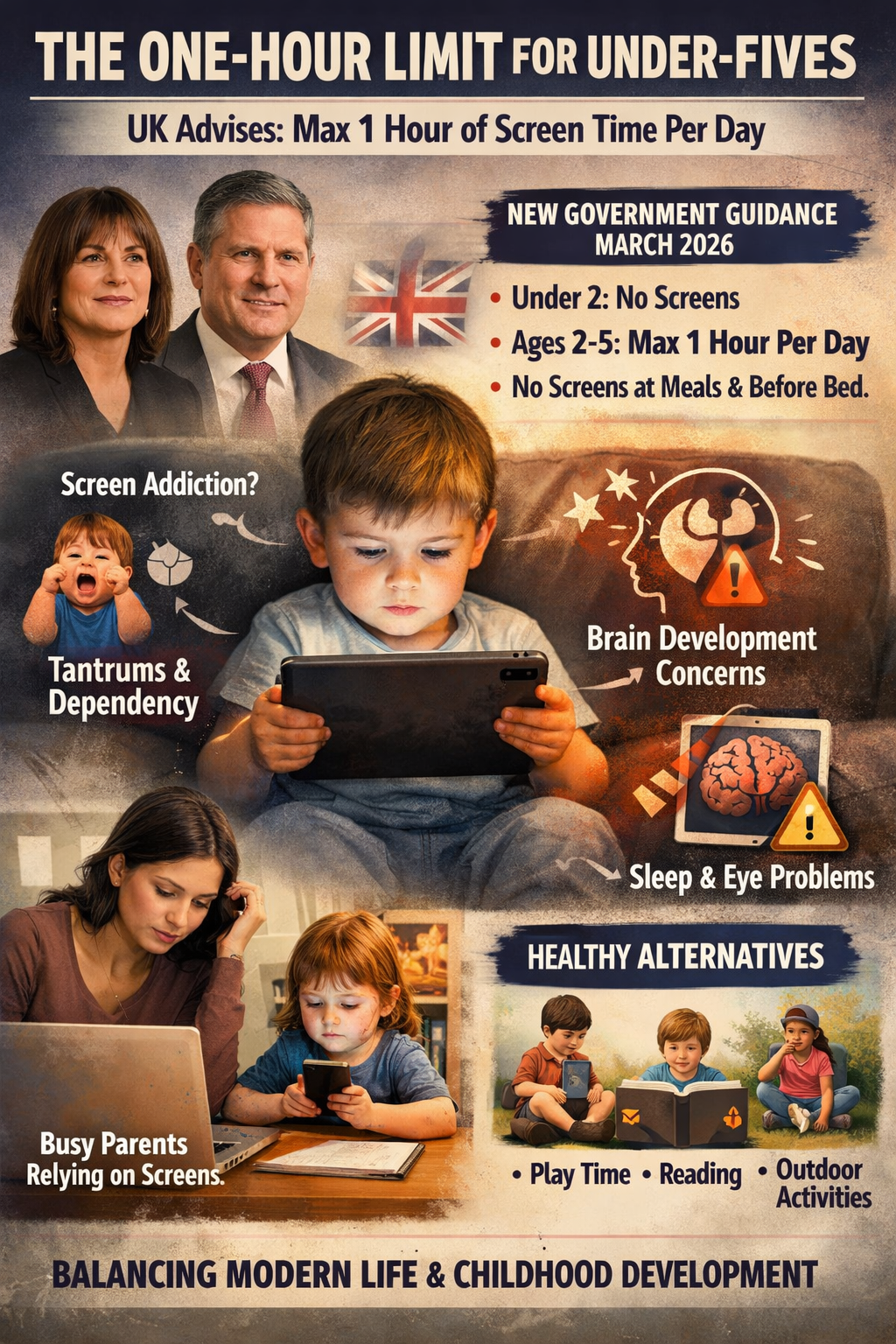


A New Rule for a Digital Generation
In March 2026, the United Kingdom formally stepped into one of the most contested areas of modern parenting: children’s relationship with screens. Backed by scientific consensus and growing public concern, the government issued guidance advising that children under five should be limited to no more than one hour of screen time per day.
The recommendation, supported by Children’s Commissioner Rachel de Souza and leading paediatric expert Russell Viner, and politically endorsed by Prime Minister Keir Starmer, marks one of the clearest national positions yet on early childhood screen exposure.
But while the policy appears simple, its implications are anything but.
The Global Origins of the One-Hour Rule
The UK’s move is not isolated. It draws directly from the global benchmark set by the World Health Organization in 2019.
The WHO guidelines recommend:
No screen time at all for children under two
A maximum of one hour per day for ages 2–4 (and less is better)
These recommendations emerged from extensive research into early childhood development, particularly the importance of real-world interaction in the first five years of life—a period when brain development is at its most rapid and sensitive.
Thus, the UK’s announcement is less a new invention and more a national enforcement of an existing global standard.
What Exactly Did the UK Announce?
The March 2026 guidance goes beyond simply setting a time limit. It outlines a broader framework for how young children should interact with digital devices:
Avoid screens entirely for children under two (except video calls with family)
Limit ages 2–5 to one hour daily
No screens during mealtimes
No screens before bedtime
Avoid fast-paced, addictive-style content, especially that resembling social media
The policy was released through government-backed child development frameworks and public health channels, following a national consultation on early years screen use.
It is part of a wider effort to address what policymakers increasingly describe as a digital childhood crisis.
Why Governments Are Now Intervening
For years, screen time was seen as a private parenting issue. That is changing.
Today, governments are treating it as a public health concern, comparable to nutrition or physical activity.
The reasons are clear:
Rising cases of speech delay in toddlers
Increasing reports of attention difficulties
Sleep disruption linked to device exposure
Early signs of digital dependency behaviours
Experts warn that children are not just consuming content—they are being shaped by systems designed to maximise engagement.
As Keir Starmer suggested in supporting the guidance, the challenge is no longer just about parenting choices, but about protecting children from highly engineered digital environments.
The Science: What Happens When Screens Dominate Early Childhood?
The first five years of life form the foundation for:
Language acquisition
Emotional regulation
Social interaction
Cognitive development
These skills develop best through:
Human interaction
Physical exploration
Unstructured play
Excessive screen exposure interrupts these processes.
Researchers associated with Russell Viner and global child health bodies argue that screen-heavy environments can:
Reduce parent-child interaction time
Limit opportunities for imaginative play
Condition children to expect constant stimulation
Eye health is another concern, with increased focus on digital eye strain and early vision problems.
The Reality: Parenting in a Time-Poor World
Yet for many families, the guidance feels detached from reality.
Modern parenting is shaped by:
Long working hours
Dual-income households
High childcare costs
Reduced extended family support
In this context, screens have become what might be called “digital babysitters.”
A phone or tablet provides:
Immediate engagement
Predictable behaviour
Temporary relief for overwhelmed parents
This is not necessarily neglect—it is adaptation.
A parent working from home, managing household responsibilities, or simply needing rest may rely on screens as a coping mechanism. The device becomes a tool for survival in a system that offers limited support.
The Rise of Early Digital Dependency
One of the most alarming trends is how early children are forming strong attachments to devices.
Parents and educators report:
Tantrums when screens are removed
Loss of interest in non-digital play
Constant requests for devices
Difficulty concentrating without stimulation
While not always clinically classified as addiction, these patterns resemble dependency.
Digital content—fast-paced, colourful, reward-driven—is designed to hold attention. For young brains, this can reshape expectations of how the world should feel: immediate, stimulating, and endlessly engaging.
Public Reaction: Support, Skepticism, and Frustration
The UK guidance has triggered a wide spectrum of responses.
1. Health experts: “Overdue and necessary”
Child development specialists overwhelmingly support the move.
Rachel de Souza has emphasised that early childhood must be protected from excessive digital exposure, noting that developmental foundations are laid before formal schooling begins.
For experts, the guidance is not restrictive—it is protective.
2. Parents: “Easier said than done”
Many parents agree with the principle but struggle with implementation.
Common concerns include:
“What do I do while working?”
“How do I manage multiple children?”
“What replaces the screen in real terms?”
For these families, the policy risks feeling like idealistic advice without structural support.
3. Critics: “Too little or too much”
The policy has also sparked political and cultural debate.
Some argue it does not go far enough, calling for stricter controls on tech companies
Others see it as government overreach into family life
Internationally, countries such as France are even considering stricter measures, including stronger limitations on screen exposure for very young children.
The Deeper Conflict: Science vs Society
At the heart of the issue lies a fundamental contradiction:
Science says: children need less screen time
Modern life demands: parents rely on screens
This gap explains why:
Compliance is low
Guilt among parents is high
Debate continues
The issue is not just behavioural—it is structural.
Without:
Affordable childcare
Flexible working conditions
Community support systems
screen reduction becomes a personal burden rather than a shared societal responsibility.
Towards a More Realistic Approach
Rather than rigid enforcement, a more effective response may lie in practical adaptation.
Key strategies include:
Prioritising quality content over passive consumption
Establishing screen-free routines (meals, bedtime)
Encouraging accessible alternatives like play and storytelling
Using screens intentionally, not reflexively
Crucially, this approach recognises constraints while still promoting healthier habits.
Redefining Childhood in a Digital Age
The UK’s one-hour screen-time guidance represents more than a parenting tip—it signals a broader shift in how societies understand childhood in the digital era.
Rooted in global standards from the World Health Organization and reinforced by national leadership, the policy reflects growing concern about the long-term effects of early digital exposure.
Yet its success will depend not only on parental discipline, but on how well societies support families navigating modern life. Ultimately, the challenge is not simply to reduce screen time. It is to reimagine childhood itself—balancing technological reality with the timeless human needs of connection, play, and presence.
Comments
About Author