


Damara (Central African Republic) (AFP) – The dusty road that leads from the Central African town of Damara to the capital some 75 kilometres (45 miles) away is filled with families on foot fleeing the latest deadly clashes between rebels and vigilante groups, leaving behind a ghost town.
Traumatised and homeless, residents of the once 30,000-strong town say an international intervention in the strife-torn Central African Republic can’t come soon enough.
Too scared to stay in their homes, they say they hope to find safety in Bangui, where reinforcements of French and African troops are arriving — causing an exodus of fighters from the Seleka rebel group that overthrew the government in March.
“The Seleka people kill any which way,” said one young man on the road to the capital, not wanting to give his name.
All around him are pockets of people, carrying what belongings they could grab on their heads, while others push full-to-the-brim wheelbarrows. Many say they are haunted by the violence they have witnessed in recent days, accusing both the ex-rebels and their rival vigilante groups of reprisal attacks.
“There have been deaths,” the young man told AFP, unable to give a toll. He said he himself saw two men put in the ground.
The impoverished, landlocked nation of 4.5 million people was plunged into chaos after the March coup by the mostly Muslim Seleka rebels.
The Seleka have since been disbanded, but rights groups say the motley crew of ex-rebels have taken to looting and burning villages, killing inhabitants who fail to flee.
Locals in the majority Christian country have responded by forming vigilante groups known as “anti-balaka” (anti-machete). The ensuing clashes have taken on a religious undertone, raising fears of sectarian massacres.
Amid growing international concern, France last week announced plans to deploy 1,000 troops to its former colony, with 200 arriving last Sunday.
A beleaguered 2,500-strong African-led force known as MISCA has also been boosted by 500 troops from the neighbouring Republic of Congo, while the United Nations is set to vote on creating a large peacekeeping force for the country.
On the road to Bangui, grim-faced locals nervously turn their heads at the sound of the odd passing motorbike or car, ready to hide in the bush at a moment’s notice.
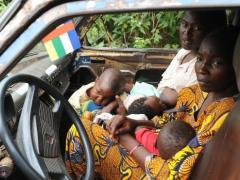
One of the vehicles is a beat-up old pick-up truck, packed with women and children. Pulling up to speak to AFP, one passenger said: “We are too scared, we’re leaving.”
The woman added that she had to bury her husband before leaving Damara.
“You have to have a brave heart to pass through here,” said another man making the same journey.
One father also trying to lead his family to safety said the country was anxiously awaiting an international military intervention.
“We heard on (the radio) that the French are coming. May they come quickly. It’s been going on too long.”
Deserted homes, empty market
Closer to Damara, soldiers man checkpoints in a tense atmosphere.
In the town itself, dotted with mango trees, the houses are empty and the streets deserted, save for two women and two children who risked a quick trip back from their hiding place to fetch provisions.
“We came to find salt. We’re going back into the forest,” said one of the women.
At the nearby market, a handful of stalls are open, though customers are few and far between.
“Normally, it’s very lively here,” said truck driver Mamadou.
Close by, a soldier stumbles out of a shack, his steps unsteady, a grenade in each hand. “What are you doing here?” he asked reporters.
Another soldier and a superior officer come out to join him.
“We didn’t do anything,” said the first soldier, without waiting for a reply to his question. “The people left on their own.”
Whispering so as not to be overheard by the troops, a woman nearby told AFP: “All the men are hiding in the bush. They are looking for th
Comments
About Author



Comments Closed .