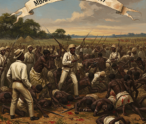
How colonial land seizures, forced relocations and the redrawing of traditional boundaries transformed Zimbabwe’s hereditary leadership system — and why disputes over ancestral territories continue more than 130 years later.
By Princess Eugene Majuru | News of The South
When British colonialists occupied the territory now known as Zimbabwe, they did not simply seize land for European settlement. They also transformed the political authority attached to that land, changing traditional boundaries, displacing communities and placing African chiefs under colonial administrative control.
For centuries before colonial occupation, African communities had governed their territories through established kingdoms, royal dynasties, chieftainships and customary institutions.
Land was more than a geographical possession. It represented ancestral identity, political authority, sacred responsibilities, burial grounds and the historical relationship between ruling families and their communities.
A king or chief could exercise authority over land through hereditary succession, customary recognition and relationships with subordinate leaders.
However, the arrival of the British South Africa Company in 1890 introduced a new system in which colonial officials increasingly determined administrative boundaries, recognised chiefs and decided where African communities could live.
Some traditional leaders retained recognition. Others were displaced, demoted or removed. Existing jurisdictions were reorganised, while communities were relocated into areas governed under different administrative arrangements.
These changes created the possibility that chiefs recognised by colonial authorities could exercise jurisdiction over territories historically associated with other ruling families.
The question is whether such arrangements were temporary instruments of colonial control or whether their consequences remain embedded in Zimbabwe’s present traditional leadership system.
More than four decades after independence, this question remains relevant to royal families seeking the restoration of traditional institutions disrupted during colonial occupation.
Among them is the Mbari royal house of Harare, whose descendants maintain that their ancestral authority was displaced when colonial occupation transformed the territory into Salisbury.
The broader issue is one that Zimbabwe must confront through historical evidence rather than assumptions: did colonial administration alter the relationship between hereditary rulers and their ancestral territories, and have those changes ever been fully reviewed?
Colonial authorities did not merely take land — they changed who governed it
One of the most important findings in the historical record is that colonial authorities exercised powers not only over land ownership but also over the composition and jurisdiction of traditional communities.
Under early Southern Rhodesian administrative arrangements, the colonial government claimed authority to appoint chiefs, divide communities and combine existing groups into new administrative units.
This meant that political boundaries could be changed through colonial decisions rather than through the customary processes of the affected communities.
A territory historically associated with one royal lineage could be incorporated into a different administrative district.
A community could be relocated into an area already governed by another recognised chief.
An existing traditional leader could be demoted while another was elevated.
These were not merely theoretical possibilities.
Historical studies document instances in which displaced communities were placed under traditional authorities other than those who had previously governed them.
The consequences were profound.
A family that had exercised hereditary authority over its ancestral territory could find itself living under another chief, not necessarily because of conquest under indigenous customary law, but because colonial administrators had reorganised the territory.
Over time, those administrative arrangements could become established features of the recognised traditional leadership system.
The result was the possibility of competing claims: one based on ancestral authority and another based on official recognition.
The Land Apportionment Act of 1930 deepened the displacement
The Land Apportionment Act of 1930 formalised racial divisions in land allocation in Southern Rhodesia.
Large areas were reserved for European settlement and commercial agriculture, while African communities were restricted to designated territories.
The legislation had consequences beyond agricultural production.
Traditional rulers whose ancestral lands fell within areas designated for European occupation could lose their territorial base.
Some were relocated with their communities.
Others were moved into areas under the jurisdiction of different chiefs.
The relationship between land and hereditary authority was consequently disrupted.
In precolonial governance, territorial relationships could involve royal ancestry, tribute, political alliances, spiritual responsibilities and customary rights.
Colonial land policy often replaced these relationships with administrative boundaries established for settler interests.
This created an important distinction between the historical territory of a royal family and the area over which it was subsequently permitted to exercise official authority.
The two were not always the same.
The Chimbwerere case: When a displaced chief’s people came under another chief
The history of the Chimbwerere chieftainship in Guruve provides a documented example of the problem.
Historical research records that the Chimbwerere community lost ancestral land through European commercial agricultural expansion.
Its people were subsequently required to recognise the authority of Chief Chipuriro, while the Chimbwerere chieftainship was eventually abolished by the colonial administration.
After independence, the community pursued restoration and sought the return of ancestral territory.
Its experience illustrates how land dispossession and traditional leadership displacement could operate together.
The loss of land was accompanied by a loss of recognised jurisdiction.
The community’s historical identity did not necessarily disappear, but its relationship with the recognised traditional leadership system changed.
This case demonstrates why contemporary restoration disputes cannot always be resolved simply by identifying the chief currently recognised in a particular area.
The historical question is whether that jurisdiction reflects longstanding customary authority or an arrangement imposed after colonial displacement.
It also illustrates why the restoration of a title and the restoration of territorial jurisdiction may involve separate legal questions.
Colonial administrators could promote one chief and demote another
Research into colonial traditional leadership in Zimbabwe shows that Native Commissioners exercised significant influence over the appointment, promotion and removal of chiefs.
Some rulers were punished for resisting colonial demands.
Others received greater recognition because colonial officials considered them cooperative.
In the Bukalanga area, historical research identifies Chief Gambo as a traditional leader whose cooperation during the 1896–1897 resistance contributed to his promotion within the colonial administrative system.
This example shows how colonial recognition could influence the hierarchy between traditional authorities.
But an important distinction must be maintained.
Promotion under colonial rule does not automatically establish that a chief lacked hereditary legitimacy.
A historically recognised ruler could receive additional administrative powers without losing the customary foundation of his original position.
The question is whether the additional authority corresponded to an existing customary relationship or was created through colonial administrative preference.
Where a promotion affected other royal houses or traditional communities, the historical circumstances deserve examination.
What happened when chiefs lost their ancestral territories?
For displaced royal families, the consequences could extend across generations.
The loss of ancestral territory could mean the loss of places where traditional ceremonies were performed, ancestors were buried and customary authority was exercised.
Communities might become separated from the sites associated with their history.
Royal families could be dispersed, while their descendants grew up under the jurisdiction of other recognised chiefs.
Over time, colonial administrative records could identify the new chief as the recognised authority without fully explaining the historical displacement that produced the arrangement.
This creates a challenge for modern historical research.
A colonial register may establish who held official authority at a particular date.
It does not necessarily establish who governed the territory before occupation.
Nor does it automatically explain whether an earlier ruling family was displaced, absorbed into another jurisdiction or removed from recognition.
A comprehensive investigation must therefore examine the sequence of events rather than relying exclusively on the final administrative arrangement.
Harare and Mazowe: What happened to the Mbari royal territory?
The history of Harare raises questions about the relationship between colonial settlement and indigenous political authority.
Before the Pioneer Column established Fort Salisbury in September 1890, African communities occupied the surrounding landscape.
The Mbari royal house, associated with King Mbari and the Shumba Gurundoro lineage, maintains that its ancestors exercised traditional authority over Harare and surrounding areas, including parts of Mazowe.
According to the royal house’s historical tradition, colonial occupation disrupted that authority and contributed to the disappearance of the Mbari chieftainship from official recognition.
The family continues to seek restoration.
Its claim raises a question directly relevant to the colonial reorganisation of traditional jurisdictions.
If territory previously associated with the Mbari royal house was subsequently placed under different administrative or traditional authorities, when did those changes occur, and under what authority?
Were they the result of colonial land allocation, changes in district boundaries, relocation of communities or competing precolonial customary claims?
Were members of the Mbari royal house consulted?
And what evidence exists concerning the original succession arrangements?
These questions require examination of early colonial maps, Native Commissioner correspondence, historical land records, genealogies and oral traditions.
The existence of the Mbari claim does not, by itself, establish that any particular present-day chief unlawfully occupies the family’s ancestral jurisdiction.
But neither should present administrative boundaries be treated as conclusive evidence that the same traditional jurisdictions existed before 1890.
The historical relationship must be investigated.
Did the creation of Salisbury erase traditional boundaries?
The establishment and expansion of Salisbury transformed the administration of the surrounding territory.
Land that had previously been occupied and used under indigenous systems became subject to colonial planning, settlement and property arrangements.
Over subsequent decades, the urban settlement expanded into the modern capital.
This transformation complicates questions of traditional authority.
A historical royal institution may have exercised authority over land that is now occupied by government buildings, residential suburbs, commercial developments and municipal infrastructure.
The modern city operates under elected local government and national legislation.
Restoring a historical chieftainship would therefore not automatically restore control over all land associated with a claimed ancestral territory.
However, urbanisation does not remove the historical question.
A city can preserve and acknowledge indigenous political history even where the legal powers of traditional institutions have changed.
For Harare, the central issue is whether the country’s historical and administrative records adequately recognise the African authorities that existed before the colonial settlement.
Can one chief inherit another royal family’s ancestral territory through government recognition?
This question goes to the heart of the debate.
Under modern law, a chief’s jurisdiction is established through legally recognised traditional leadership arrangements.
But historical customary authority may have developed through different processes.
If a colonial administrator transferred a community into another chief’s jurisdiction, that decision could establish an administrative relationship without necessarily settling the historical ancestry of the displaced community.
The distinction between administrative jurisdiction and hereditary identity is important.
A government may recognise a chief over a particular area.
That recognition does not automatically mean the chief’s ancestors exercised the same authority over that territory before colonial occupation.
Equally, a family claiming earlier authority must establish the historical and customary basis of its claim.
The law must consider both the rights of existing communities and the historical evidence presented by displaced royal lineages.
A restoration process should not assume that every colonial boundary was illegitimate.
But it should be capable of examining whether particular boundaries resulted from colonial interference rather than customary agreement.
Why colonial maps cannot tell the whole story
Colonial maps are valuable historical documents.
They can show administrative districts, settlement patterns, reserves and officially recognised jurisdictions.
However, they were generally prepared to serve colonial governmental objectives.
Their boundaries may not accurately represent earlier customary relationships.
A precolonial ruler’s influence might extend through subordinate chiefs, tribute relationships, alliances or spiritual responsibilities that were not recorded as fixed geographical boundaries.
Colonial administrators often preferred clearly defined districts because they simplified taxation, policing and administration.
This could transform more flexible political relationships into rigid territorial jurisdictions.
Consequently, a map showing the boundaries of a chieftainship in 1930 cannot automatically establish the extent of the same institution’s authority in 1800.
Historical researchers must compare maps from different periods with oral traditions, genealogical evidence, settlement histories and contemporary written records.
Only then can the evolution of a traditional jurisdiction be properly understood.
Why some displaced royal families struggle to prove their claims
The passage of time presents serious challenges.
Some royal families lost written records during conflict or displacement.
Others preserved their histories through oral traditions that were never formally documented.
Colonial officials sometimes recorded African names incorrectly, used alternative spellings or described traditional political relationships according to European administrative categories.
Families may also disagree about succession, territorial boundaries or the interpretation of historical events.
These difficulties can make restoration claims complicated.
But complexity should not be confused with the absence of a legitimate historical grievance.
A credible process should permit different forms of evidence to be considered.
Colonial correspondence can establish administrative decisions.
Genealogical records can assist in tracing hereditary succession.
Oral traditions can preserve historical relationships not adequately recorded in written archives.
Archaeological and geographical evidence may also contribute to understanding settlement and territorial history.
No single category of evidence should automatically determine the outcome.
Did independence restore the land but not the traditional authority?
Zimbabwe’s land reform programmes significantly changed patterns of land ownership established during colonial rule.
However, redistribution of agricultural land and restoration of hereditary traditional jurisdiction are not the same process.
Land reform may transfer land rights without determining which royal house historically exercised customary authority over the territory.
Similarly, restoring a chieftainship does not automatically transfer ownership of all land associated with its ancestral history.
These distinctions help explain why some traditional leadership disputes continued after independence and subsequent land redistribution.
A royal family may regard the return of land to African occupation as incomplete historical justice if its ancestral leadership institution remains unrecognised.
An existing chief may argue that current community relationships and lawful jurisdiction must also be protected.
Both concerns require consideration.
Historical justice cannot be achieved by disregarding the rights of people currently living within disputed territories.
Who should investigate colonial territorial transfers?
Zimbabwe’s constitutional framework recognises traditional leadership and requires appointments, succession and restoration to respect the customs of the communities concerned.
But territorial disputes involving colonial displacement may require more extensive historical investigation than ordinary succession cases.
The National Council of Chiefs, relevant provincial assemblies, the Ministry of Local Government and independent historical specialists all have potential roles within their lawful responsibilities.
A properly constituted investigation could establish the original customary jurisdiction, the circumstances of colonial intervention and the subsequent administrative changes.
It should also identify affected communities and any competing claims.
Such an investigation would need to distinguish between historical findings and contemporary legal remedies.
A conclusion that a royal family historically exercised authority over a territory does not necessarily mean that all modern jurisdictional arrangements must be reversed.
But historical recognition can provide a foundation for lawful restoration, cultural acknowledgement or other appropriate remedies.
Could Zimbabwe establish a historical register of ancestral territories?
One possible response would be the development of a national historical register documenting precolonial royal institutions and the territorial changes imposed during colonial rule.
Such a register could identify traditional jurisdictions before occupation, record subsequent administrative alterations and preserve evidence concerning displaced royal families.
It could also assist in resolving succession disputes.
However, the register would need to distinguish established historical findings from contested claims.
It should not become a mechanism for automatically transferring land or chiefly authority.
Its primary purpose would be historical accountability.
A reliable record could also contribute to education, heritage protection and public understanding of Zimbabwe’s indigenous political systems.
For communities whose histories were marginalised by colonial administration, such work could preserve important knowledge for future generations.
The danger of allowing colonial administrative decisions to become unquestionable history
The central difficulty is that colonial authorities possessed the power to change traditional jurisdictions.
Once those changes were recorded in official documents, later administrations could inherit them as established arrangements.
Over generations, the historical circumstances behind the changes might become less visible.
An administrative decision made by a Native Commissioner could eventually be treated as though it represented an ancient customary boundary.
That possibility deserves careful scrutiny.
It does not establish that every modern chiefly jurisdiction is historically incorrect.
But it demonstrates why official recognition alone cannot answer every question about ancestral authority.
The historical record must distinguish between what existed before colonial occupation and what colonial administrators subsequently established.
Conclusion: The land was taken, but was traditional authority transferred with it?
British colonial occupation transformed Zimbabwe’s relationship with land and traditional leadership.
African communities were displaced from ancestral territories.
Traditional jurisdictions were reorganised.
Some chiefs lost recognition, while others acquired administrative authority over communities or territories previously associated with different leadership institutions.
The historical record establishes that these changes occurred.
What remains unresolved in particular cases is whether the consequences of those changes continue to shape contemporary traditional leadership disputes.
The Chimbwerere experience demonstrates how a displaced community could come under another recognised chief.
The Mbari royal house’s restoration claim raises questions about what happened to indigenous authority in the territory that became Harare.
Other communities may possess different histories requiring separate examination.
The challenge for Zimbabwe is to investigate these claims without assuming that every colonial arrangement was illegitimate or that every ancestral claim is automatically valid.
Existing chiefs deserve fair treatment.
Displaced royal families deserve an opportunity to present their evidence.
Communities deserve protection from arbitrary changes to their customary institutions.
And the historical record deserves to be examined beyond the administrative boundaries established by colonial officials.
The central question is not simply who governs a traditional territory today. It is who governed that territory before colonial occupation, how authority changed hands and whether those changes reflected customary legitimacy or colonial administrative power.
More than 130 years after the Pioneer Column entered Mashonaland, Zimbabwe continues to confront the consequences of land dispossession and the restructuring of indigenous authority.
The country cannot resolve every historical injustice by returning to precolonial boundaries.
But it can establish what happened, recognise the communities affected and ensure that legitimate traditional leadership claims are examined fairly.
Colonialism changed who controlled the land. The unfinished historical question is how far it also changed who was recognised as having the right to rule it.
Comments
About Author