

By HRH Princess Eugene Majuru
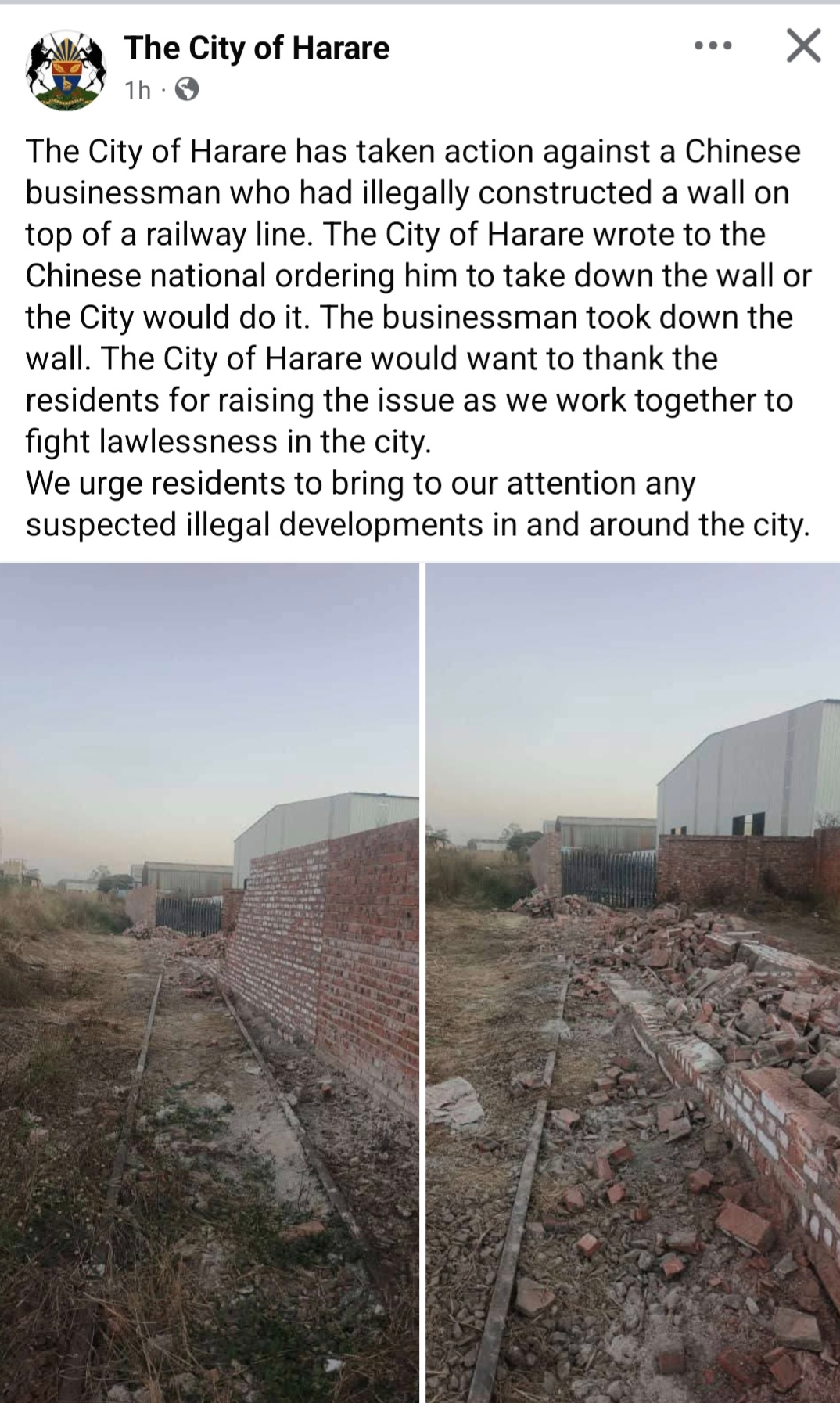
Harare, Zimbabwe ( News of The South) – A wave of anger and disbelief has swept through Harare after images circulated online showing a newly constructed brick wall directly on top of a railway line in the Willowvale industrial area. Residents who shared the shocking pictures expressed outrage, questioning how such a blatant disregard for infrastructure could occur. The images quickly went viral, eventually reaching the Harare City Council, who confirmed the structure was built without their approval.
In a statement released on their Facebook page, the Harare City Council stated they had instructed the Chinese businessman responsible for the construction to remove the wall, failing which the council would take action themselves. While the council’s polite approach to the foreign national has been noted, it has also ignited accusations of double standards. Many Zimbabweans are pointing to the council’s alleged history of heavy-handed demolitions of local structures without warning, contrasting it sharply with their seemingly gentle directive in this instance.
The National Railways of Zimbabwe (NRZ) has since clarified that the affected line is a disused, privately-owned siding that once served a now-defunct factory. The property was reportedly purchased last year by a Chinese-owned company, which erected the wall for security purposes. While the NRZ claims no jurisdiction over the disused line, they acknowledged the inappropriateness of the construction and deferred the matter to the City Council.
However, the incident has brought to the forefront serious questions about land management and the competence of the Harare City Council. Critics are questioning how land so close to a railway line, even if currently disused, could have been sold for development without proper due diligence and consideration for future railway infrastructure needs. There are also concerns about a building reportedly constructed close to the same railway line, raising further questions about planning oversight.
“This is beyond negligence – it’s absurd,” commented one urban planner who saw the images. “You don’t build on railway lines, disused or not. It sets a dangerous precedent and shows how far planning laws are being ignored.”
The incident has amplified long-standing accusations of corruption and incompetence within the Harare City Council. Residents and civic groups allege that the council’s insatiable appetite for revenue has led to the indiscriminate sale of land, often without proper planning or adherence to regulations. This alleged “looting” of land resources is seen as a major contributor to the city’s current state of disarray and infrastructural challenges.
Investigative journalist Hopewell Chin’ono weighed in on the matter, stating that constructing any permanent structure on a former railway line requires a change of land use approval, building permits from the City of Harare, and environmental clearance. He challenged both the NRZ and the Harare City Council to produce documentation proving the wall’s approval through legal channels.
As of Wednesday morning, reports indicate that workmen were seen demolishing part of the wall. While the council has taken action, the incident serves as a stark reminder of the potential consequences of poor urban planning and alleged corruption in land management. It also raises critical questions about equitable treatment under the law, depending on one’s nationality.
The Importance of Setback Distances from Railway Lines
Globally, maintaining adequate setback distances from railway lines is a crucial aspect of urban planning and infrastructure safety. These distances are not arbitrary; they are established to mitigate various risks and ensure the long-term functionality of railway corridors. Some of the key reasons for these setbacks include:
Safety: Maintaining a buffer zone reduces the risk of damage to structures and injury to occupants in the event of a train derailment or accident. The force of a derailment can send debris flying and impact areas close to the tracks.
Noise and Vibration: Railway operations generate significant noise and vibration. Adequate setbacks help to attenuate these disturbances, improving the quality of life for those living or working nearby.
Future Expansion and Maintenance: Railway lines may require expansion or significant maintenance work in the future. Clear corridors ensure that such activities can be carried out without encroaching on private property or necessitating costly demolitions.
Environmental Protection: Setbacks can help protect sensitive environmental areas adjacent to railway lines and provide space for drainage and other necessary infrastructure.
Operational Safety: Maintaining clear lines of sight for train operators and ensuring sufficient space for signaling equipment and other operational necessities are crucial for safe railway operations.
While specific regulations can vary significantly between countries and even within different regions of a country, the principle of maintaining a safe and functional distance between development and railway infrastructure remains a universal standard in responsible urban planning. The incident in Harare highlights the potential chaos and conflict that can arise when these fundamental principles are ignored.
Comments
About Author