

Antonnate S. Mugodi
Dr Lazarus Chakwera in comfortable win in the presidential polls.
LILONGWE, Malawi.(News of the South)-Unnconfirmed results springing from Tonse Alliance Centre confirming a considerable win for their leader, Lazarus Chakwera.
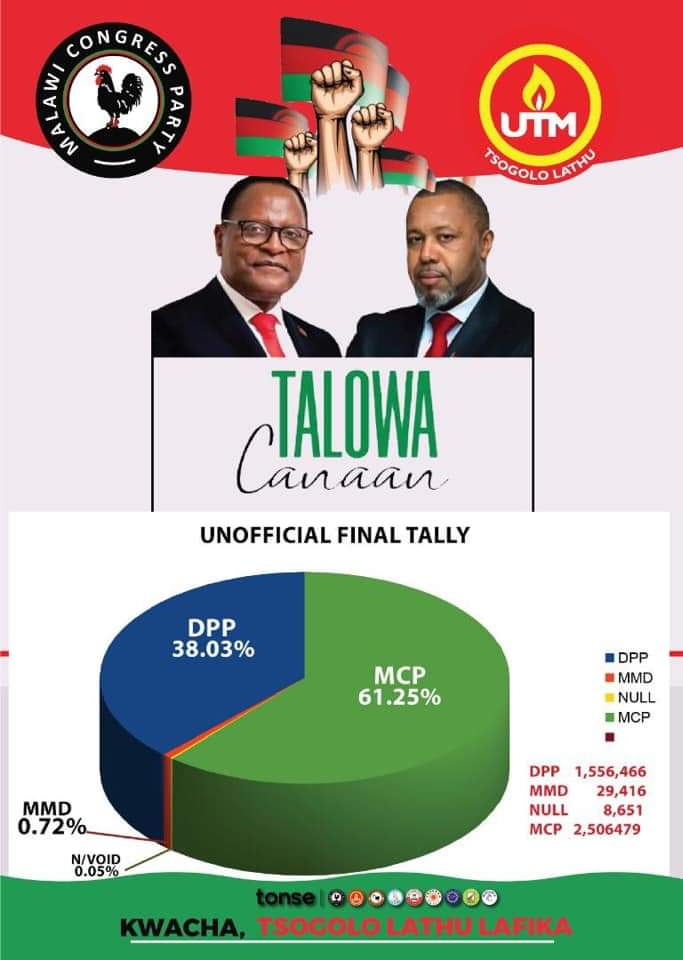
Tonse Tally Centre has put Chakwera with a considerable win of 61.25 percent over President Peter Mutharika using data that they derived from their monitors in all district tally centers across the country.
Their national figures show Chakwera soaring with 2 373 317 votes, representing 61.25 percent, over Mutharika with 1 472 108, representing 38.01 percent. Mbakuwaku is trailing with a meager 27 821 votes representing 0.72 percent.
However, Malawi Electoral Commission (MEC) says it has, so far, received 5 percent of the national votes from the district tallies.
On the same note, government has urged political party leaders and their supporters to desist from publishing fabricated results on social media amid concerns that such conduct could undermine the integrity of the political process.
Government said in a statement signed by Minister of Information Mark Botomani: “We have learned that prior to voting, some people photocopied blank MEC result sheets which are being filled with the fabricated election results in order to confuse people.
“In this way, the public is being led to believe the fake results because they look genuine on a MEC form.”
Botomani has since urged political party leaders and their stakeholders to manage their expectation on the outcome of the poll while the Malawi Electoral Commission completes tabulating the votes in the fresh presidential election.
The vote was necessitated after courts nullified the results of the May 2019 election. Some 6.8 million Malawians are eligible to cast ballots at more than 5,000 polling stations across the country.
The Constitutional Court on February 3, 2020 ordered that the election be held again, ruling that the first results were not valid because of widespread evidence of irregularities and vote tampering.
The court struck down the victory of incumbent President Peter Mutharika citing evidence of voting fraud, including thousands of ballots that appeared to have been altered using typing correction fluid. The ruling was upheld by the Malawi Supreme Court.
In the 2019 polls, seven presidential candidates contested but now the number has come down to two. The 79-year-old Mutharika, looking for a second and final five-year term in office is up against the leader of the opposition Malawi Congress Party, Lazarus Chakwera, 65.
Incumbent Vice President Saulos Chilima was also expected to run, but he decided instead stand as Chakwera’s vice-president, in a bid to maximize chances of unseating Mutharika.
The contest appears to be very close. The Chakwera/Chilima ticket may win 51% of the vote, according to a poll in early June by Malawi’s Institute of Public Opinion and Research.
Malawi is one of few African countries that has still recorded below 1,000 coronavirus cases as of today. The official case load stood at 749 cases.
Photos and videos of people at voting centers showed a disregard for health protocols as people were cramped together in long winding lines without the physical distancing rules, very few people were seen wearing masks including top politicians.
The Malawi Electoral Commission officers were however seen in gloves and masks as they administered voting procedures and materials to members of the public.
Local media have reported that voting is also ongoing in a number of prison facilities across the country. The process has been smooth except for a few places where opening of voting has been delayed for a number of reasons.
Malawi joins a number of African countries that went ahead with elections despite the virus . Burundi, in May 2020; held general elections with the presidential race returning the ruling party candidate Evariste Ndayishimiye as winner.
Mali held legislative elections in March as did Guinea where partial legislative elections and a constitutional referendum were held in March this year. The United Nations in all cases cautioned authorities to take all necessary measures to avoid spread of the virus.
Comments
About Author