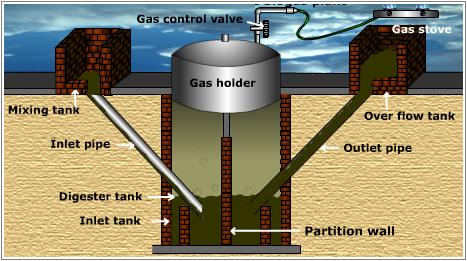


By Wallace Mawire.
At least 2 000 bio-gas digesters have been installed throughout Zimbabwe as rural communities embrace new alternative and cleaner renewable energy solutions.
According to Isaac Chiridza, Senior Energy Development Officer with the Ministry of Energy and Power Development, there are three biogas programmes underway in Zimbabwe.
These include the institutional biogas programme which involves construction of biogas digesters at schools, hospitals and colleges to reduce their dependence on electricity and firewood for cooking.
Chiridza said that 33 digesters were constructed countrywide in 2015 under that programme. The municipal biogas digester programme has seen completion of the Kotwa Digester of 350 cubic meters capacity, the Mbare digester is under construction.
“The Ministry is encouraging the country’s municipalities to utilize the gas from sewage treatment plants for energy generation,” Chiridza said.
The domestic biogas digester programme targets to build about 7 000 biogas digesters nationwide over a five year period from 2013 to 2018.
Chiridza said that government of Zimbabwe under through his ministry is aiming to increase renewable energy resource utilisation from 115 MW to 515MW by 2020. They also aim to increase energy savings from 100 MW to 300MW.The ministry of energy is promoting
the use of sustainable renewable energy.
It is also reported that other alternative forms of renewable energy are becoming vital since the country has only 40% of its population with access to the national grid electricity. In Zimbabwe, it is reported that 19% of the population in the rural areas has access to
electricity from the national grid. Chiridza said that this has emphasized the need to accelerate alternative renewable energy solutions.
Linda Chitemere of Veneka Power (Pvt) Ltd said that municipalities, industry and agricultural operations are currently battling with profitability which is exacerbated by erratic power supplies, at times meanwhile outputting resources from their operations which have been traditionally termed ‘waste’, that they have been ‘throwing away’.
“However, due to technological advancements, waste is no longer waste as we used to know it and in some economies this waste commands quite significant prices,” Chitemere said.
Her organisation is conducting training to educate communities on how to harness this ‘waste’ resource and turn it into biogas for conversion into electricity and heat or vehicle fuel, resulting is a net reduction of their cost structures and improve profitability.
According to Soneni Ncube, former Project Manager, for the HIVOS Green Programme the Zimbabwe Domestic Biogas programme is part of initiatives contributing to the Sustainable Energy for All (SE4All) agenda in the country.
The ZDBP is an initiative of five partner organisations initiated in 2013 following a market and feasibility study in 2012.The first phase of the initiative has been a pilot project to prove the concept of market driven delivery of the biogas programme.
The initiating partners are HIVOS, SNV, Ministry of Energy and Power Development, Ministry of Agriculture, Mechanisation and Irrigation Development and the Rural Electrification Agency (REA).
The programme was developed to answer to Sustainable Energy for All and Zimbabwe’s government policy objectives to promote clean and renewable energy to mitigate climate change.
The goal of the programme are to develop the national biogas market sector to serve over 63 500 households with clean cooking energy. The objective of the programme is to improve the livelihoods of at least 7 600 rural farmers by enhancing access to sustainable energy in
line with SE4All principles and sustainable development goal 3 to provide affordable clean energy to all.
Key components of the biogas advancement programme have involved training of trainers, quality control, training of biogas component enterprises to manufacture stoves, distribute pipes and plumbing materials, advisory support, monitoring and evaluation, financial
product development for credit schemes, gender mainstreaming and funding including policy issues.
According to HIVOS, the biogas programme has seen at least 4000 rural households in eight provinces of the country being informed about biogas.
At least 74 masons, 18 stove fabricators and 102 promoters have been trained under the programme. The programme has also seen 168 digesters being installed countrywide.
“The Zimbabwe Domestic Biogas programme is one of the few projects significantly addressing energy for cooking which is mostly ignored in the country,” Ncube said.
Some of the benefits of using biogas energy include minimising carbon emissions into the atmosphere and providing lighting in the evening for rural households. Bio-slurry also increases productivity
of crop yields and cattle feedlots.
Other benefits include improved agricultural productivity enhancing household nutrition and income, job creation through construction and maintenance of digesters, modernisation of rural kitchens reducing smoky kitchens and reducing use of wood for cooking thereby reducing
deforestation rates.
The biogas initiatives in Zimbabwe are coming at a time when when the Ministry of Energy and Power Development has just launched the renewable energy policy development process. The Renewable Energy
Policy (REP) is amongst a raft of policies that are under consideration by government and are subsets to the National Energy Policy (NEP) of Zimbabwe. The renewable energy policy provides the energy consuming public with a variety of options on acquiring energy as well as generating some of it, and biogas is one of the other options which all communities can embrace to counter energy poverty
issues affecting the country.
About Author