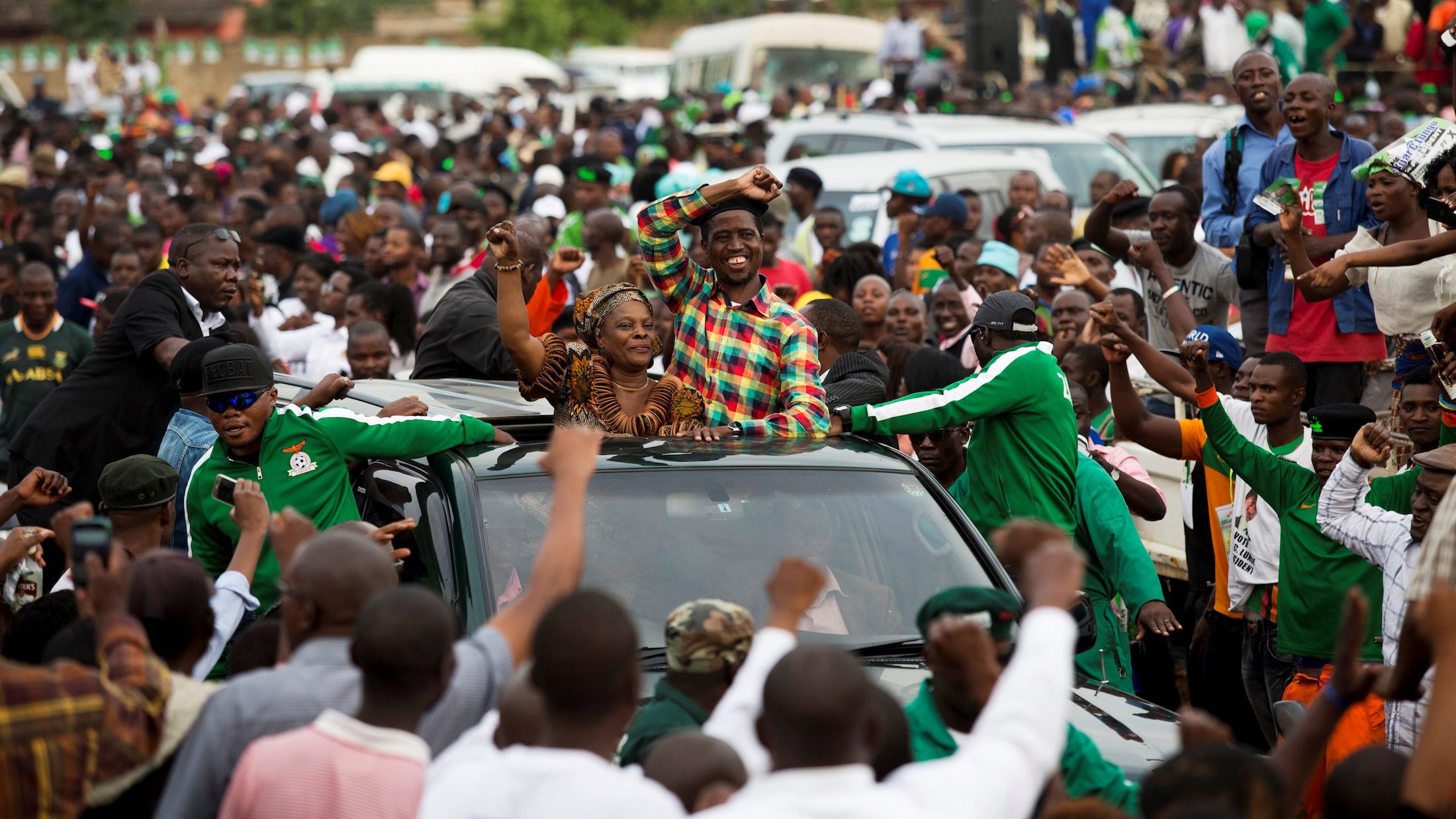


Harare, Zimbabwe (News of the South)-The recent Zambian tripartite elections provide a disturbing foretaste of what the forthcoming 2018 Zimbabwean elections may be like with a dosage of political violence, vote-buying and allegations of rigging clouding the proceedings according to the Election Resource Center (ERC).
Zambia experienced street clashes in the run up to the elections which have since been won by incumbent President, Edgar Lungu of the Patriotic Front, who polled 1,860,877 votes while his closest challenger, Hakainde Hichilema, of the opposition United Party for National Development (UPND), received 1,760,347.
The result put paid to any run-off as Lungu managed to amass the more than 50% share of votes as for the first time the Zambian electoral laws required the winner to have more than 50% to avoid a run-off.
Opposition parties have since vowed to contest the results in the constitutional court alleging massive vote rigging through collusions between the PF and the Electoral Commission and the ERC which was part of the organisations that monitored the Zambian elections has predicted a similarly rocky path for Zimbabwe in 2018.
Zimbabwe is facing a watershed moment in the 2018 elections likely to be contested between the ruling ZANU PF and a coalition of opposition parties, and with rifts apparent in both the ruling party and Tsvangirai’s MDC, the stage is set for a riveting experience.
“The environment leading to the Zambian election drew certain trends that must be reinforced in line with the SADC Guidelines and Principles governing free and fair elections in Southern Africa”.
“Among these, limited access to public media by opposition political parties and closure of the main private media house and unprecedented levels of politically motivated violence”.
“They were allegations of vote buying, (and) reports by ZEIC indicate some Patriotic Front (PF) and the United Party for National Development (UPND) candidates were reportedly giving out money to voters in exchange for votes”, ERC said.
The issues of violence and a partisan media have become staple controversial topics in Zimbabwean elections and 2 years before the next election still remain hot topics with allegations against both parties and government’s seeming lack of resolve to deal with the issues.
”The ERC took a keen interest in the Zambian election due to the various similarities between Zambia and Zimbabwe in terms of the Electoral Act, Electoral System and use of a biometric system”.
Zimbabwe is considering the adoption of biometric voter registration according to Joyce Kazembe the Zimbabwe Electoral Commission Chairperson (ZEC) though some political players such as Elton Mangoma have already voiced their opposition to its unilateral adoption.
“Zambia therefore provides both negative and positive lessons for Zimbabwe ahead of the 2018 General Election”, the organisation has said.
The 11 August Zambian tripartite election also saw voters electing Members of Parliament, Mayors, and Councillors.
The normally stable country also voted in a Constitutional referendum which sought to expand the Bill of Rights.
In a snide analysis towards the local ZEC, the ERC commended the willingness by the Electoral Commission of Zambia (ECZ) to engage with stakeholders in particular civil society and political parties.
Some analysts have however refuted the notion that Zimbabwe is set for any dramatic political shifts come 2018 and instead hinted at the ZANU PF political institution coming away from the skirmishes with a solution that will maintain its place in the corridors of power.
World Politics Professor at the school of Oriental and African Studies (OAS) University London, Stephen Chan speaking recently said all the demonstrations happening would pan out into nothing solid and were a far cry from the ground shifting Arabian springs, themselves empty revolutions that have left the people in states far worse than before.
“There will be no Arab Springs. Besides the Arab Spring brought nothing to the people of north Africa and only untold suffering to the people of Libya and Syria”.
“People can wrap as many flags around themselves as they like. This battle will be fought in the great institutions of the country. ZANU PF is one such institution.
“The army is another. I hope the judiciary will be another. And, if the church is to be an active institution in all this, it will take more than just one pastor”, he said to the media recently.
The Zambian election also had its share of glitches with the Christian Churches Monitoring Group, a Zambian NGO, alleging that 10% of the polling stations opened late whilst they were long queues in major provinces of Lusaka, Copperbelt and the Eastern province.
Unlike previous Zimbabwean elections from which most international observers have been denied entry, the Zambian elections were monitored by organisation from all over the globe including Faith Based Organisations, Civil Society Organisations, international observers such as the Southern African Development Community (SADC), the African Union (AU), the European Union (EU), the media and others.
Comments
About Author