Presentation By Naison Bangure at the Conference on Effects of Colonialism And Neocolonialism Held on May 1, 2021 via zoom (co – hosted by News of The South and Informer East Africa)
Firstly, Greetings!
I greet you all with the African continent in mind.
It’s my pleasure being here today with distinguished colleagues to unpack issues that are unfinished business on the African continent. I want to observe and respect the relevant protocols that are applicable to this conference.
I shall be addressing you from my notes here, but I will strive to achieve as much as possible, the eyeball to eyeball contact with you, that is so vital as to maximise the essence of communication.
Since the colonisation of Africa, substantial indigenous populations were displaced in a most miserable fashion. I shall not dwell on the macro issues that are associated with displacement at large, I think some of my colleagues on the panel are already doing that. My remit is to focus on the micro effect as the displacement affected people at grassroots level.
Let me disclose from the onset that I’m a son of the Mbari clan and it’s our day today. As you will soon witness, I’m only here to be as objective as possible and not to denigrate other clans as I have often seen happening.
As we well know, a large portion of African history was never documented but orally passed down through the generations. In such a situation, some of the information would have been corrupted as it cascaded down to the present day.
Colonisation has come and gone but it left behind an atmosphere that has driven various interested parties towards wanting to propagate narratives that promote their own pursuits.
Also, the waves of neocolonialism can be felt across most of Africa, as links of all sorts with the former masters have remained intact. Research work on African history must be a nightmare if what I experienced during my brief stint is anything to go by.
Interested parties have told the history of Zimbabwe to favour their tribes or clans. The coloniser has also avoided propagating written history in a way that puts themselves in bad light. In the end, what we got is a product of history, that is a mixture of half truths and distorted memory, laced with some folklore.
Several chiefdoms in Zimbabwe were living relatively peacefully before colonialism but the peace and togetherness that existed among the local people was all disrupted by colonialism.
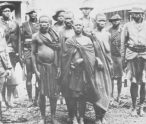
I’m not trying to open old wounds but everyone has at some point, seen some old black and white pictures that have survived the years and are now in digital form and easier to share. They depict some seriously gruesome treatment of the local people by the colonisers. The details of this can be so graphic that we have no choice but to leave it for another day.
Present day Harare was the citadel of chief Mbari, and the Pioneer Column named it Fort Salisbury. This was after their conquest of Masvingo and Chivu which they called Fort Victoria and Fort Charter respectively.
As the Union Jack was raised in Salisbury the pioneer column had completed it’s task of reaching Mashonaland, and start occupying the land and ravaging the cultures of local people. Chief Mbari’s area was the hotbed of the First Chimurenga, the nucleus of resistance from which the war spread to other regions in Mashonaland.
I shall discuss how colonialism affected people of the Mbari clan of Zimbabwe, whose totem is Shumba the lion, addressed as Gurundoro the Guru (big) Ndoro (crown). Why particularly this clan, my clan, one may ask.
After Zimbabwe independence in 1980, Salisbury was named Harare. Prior to independence, Harare was the name of the present day Mbare. The Mbari people insist however, that Harare and Mbare be spelt as Harari and Mbari respectively. That’s obviously just a by the by, a minor struggle indeed.
When white settlers came to Zimbabwe, they found closely-knit chiefdoms. There existed a sound socio-economic and political order in the country.
During the colonisation process we witnessed the bastardisation of the names of places including towns and cities where a new name that was more friendly to the tongue of the occupiers was given. Gweru became Gwelo; Mutare became Umtali; Chinhoyi,Sinoia; Marondera, Marandellas; and Kadoma became Gatooma. The settlers were a creative lot weren’t they?
I am belabouring on this point of names to dispel claims by other chiefdoms that have completely different names that Harare was their territory. Harare, Mbare, Dzivarasekwa and a number of iconic geographical features in the region are named after Mbari and his people.
We have seen that the colonisers tried to keep the original names of places as much as possible, (save for the minor changes they made in order to sweeten the names a bit for the convenience of the settler’s speech).
Salisbury became Harare in 1982 after Zimbabwe’s independence in 1980. Folklore has it that when Chief Mbari lived on the Harare Kopje, he had a fire burning all night every night and people wondered if he ever went to sleep.
That earned him the nickname Haarari, a local Shona language expression for “He does not sleep,” Harare for short! Harare’s oldest dormitory township of Mbare is named after chief Mbari. The name Harare is Mbare’s former name when the capital was called Salisbury in honour of Lord Salisbury, British prime minister at the time.
Today, the task is to establish as accurately as possible what happened to the great Mbari people, whose name litters the history of that part of the country. As a result of colonialism, some chiefs including chief Mbari lost their areas of jurisdiction while others had their territories distorted.
Till today, many chiefs have problems of boundaries across the country as a result of the colonisation that was effective from September 12 1890.
The long and short of it is that Chief Mbari’s people were hardest hit by the violence of colonialism perhaps because their territory included the capital. Despite mounting a formidable resistance, they were defeated by the rifle wielding white settlers whose tactics included dismantling the togetherness of the Mbari people.
They were displaced and went into disarray. They fled in different directions and found themselves having been disunited with their families and settling in the territories of other chiefdoms. Some are still suffering from the direct effects of colonialism.
From that period of the first Chimurenga till today, individual persons or families of the Mbari clan have had no idea about the length or breadth of their clan.
With the advent of social media, groups have now emerged on platforms such as WhatsApp and Facebook. I belong to a group of few hundred people that have since discovered one another and for the first time since the colonial days, we have some idea about the demographics regarding our ‘relatives’. It gives a rare and good experience to participate in a group knowing that every person that you deal with is from your clan.
The exodus of people from Zimbabwe to other countries in the more recent years would mean that the demographic pattern of membership has become very international. The task of restoring Mbari’s territory is still outstanding. This may be followed by the restoration of a chief. As things stand, Mbari’s territory vanished into thin air. Some of it is where the Harare CBD stands.
Many people of the Mbari clan, just like any other in Africa, believe that rituals involving spirit mediums need to be performed for guidance.
It is believed that the considerably low levels of water in the Mazowe Dam, that seemingly can’t be explained has to do with the intervention or lack of it by the ancestral protocols of the Mbari Gurundoro people.
At this juncture, one wonders if the large portions of modern society, who for instance, are church goers, would participate in sessions that involve spirit mediums.
Asked about the role of the church in all this, and to what extent the church helped colonialism, Rev Richman Ncube said, “The church played a role during colonialism. Some of it was positive and some was negative. The positives included mission schools that introduced education. They also brought vocational education including better agricultural practices.
Negative in the sense that the church championed the decultural-ization of local people where certain good practices were abandoned in favour of those which the settlers brought.
By so doing, the church was also aiding the colonial hand. Trying to re-culturalise the successive generations since then, could be an uphill task.” he said.
In a remarkable coincidence, Rev Cleopas Sibanda raised the same view of the positives brought by the church and the negatives of de-culturisation. He added that the church introduced stringent rules in order to tame the Africans, such as, ‘don’t drink alcohol and don’t smoke tobacco’.
Although not to promote these practices, but on his first visit to the English churches, much to his surprise, Rev Sibanda found that drinking alcoholic beverages or smoking tobacco, was commonplace among the clergy. It is possible that the discourse with the church ministers could create the opportunity for debate on these important issues.
Let me wind up my presentation with the observation that despite mounting a fierce resistance against the settlers, Mbari’s people, my people, with their relatively inferior weaponry were not only defeated, but trounced!
All the gallantry of Mbari’s clan effective, ended on March 1
1897 when the settlers massacred everyone in sight in Makombe’s settlement. Some escaped to the caves where they were betrayed by collaborators who were well-known. As a result, they were dynamited in their hiding place!
Remains of this First Chimurenga war, Mbuya Nehanda and others are yet to be repatriated to Zimbabwe where they are to be laid to rest.
Some of the other First Chimurenga war of resistance heroes were Sekuru Kaguvi, Chief Chingaira Makoni, Chief Mapondera, Chief Chinengundu, Chief Mashonganyika and Chief Chiwashira. They were brutally executed and their heads were taken to London as war trophies and were paraded for all to see.
Also, Zimbabwe’s history can not be complete without mentioning the unsung heroes of the resistance to colonialism such as Mudavanhu (Mukwati), Makombe, Nyamadzawo,
Mutinha and Chiridzambira. As in many other cases of trying to cite unsung heros, this list is by no means exhaustive.
The unfinished business regarding the territory for the Gurundoro people and the restoration of their crown, is known within the corridors of power in Zimbabwe. Commendable efforts are being made by the Mbari people who are now appearing from their hideouts so to speak. They are gathering under one roof to organise themselves for the purposes of engaging the appropriate government offices.
On that hopeful note – I thank you
Selah,
Asante Sana
Naison Bangure 1 May 2021
Comments
About Author