

By A Bagali.
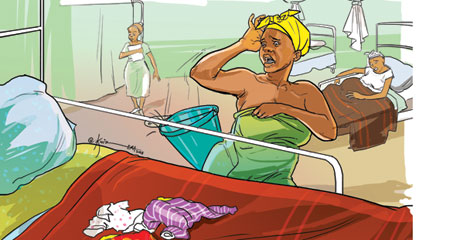
Uganda. – Heavily pregnant, Justine Namutebi looked around for a helping hand in vain. In a crowded maternity ward in Masaka Referral Hospital, Namutebi sat helpless, with no hope of help coming in.
Suddenly, she spotted a stranger smiling at her, and she smiled back. And their “friendship” began.
Friendship in a hospital is more than a chit-chat encounter; it involves giving a hand when a friend is in need. Namutebi’s new-found friend did not disappoint; she willingly went on errands, comforted Namutebi when she needed a shoulder to lean on, and acted nurse in the absence of a health worker. Namutebi thought she had found a perfect hospital friend in Betty Namanda.
When Namutebi’s labour pains intensified, Namanda, 45, came in handy. She would help fix everything that was within her means, and only excuse herself briefly to take care of a patient that Namutebi never got to meet.
When Namutebi gave birth, Namanda seemed overjoyed by the good news.
“She would pass by, pull the baby’s cheek passionately, greet us and ask whether we are getting better,” Namutebi recalls.
Namanda had become part of the family. Their friendship developed into trust. However, on the morning of October 11, 2014, Namanda betrayed this trust. After Namutebi had calmed down the baby, she rushed out for a bath, leaving her new born in the care of Namanda.
On coming back, her bed was empty. The baby had disappeared, and her friend too, had melted into thin air. She asked her neighbours about Namanda’s whereabouts, but no one had an idea.
She hurriedly dressed up, searched around the hospital but there was no trace of her friend. It was at this point that it occurred to her that her baby had been stolen.
Search for the baby
Namutebi dashed to the hospital administrators seeking help. They ran into panic. They first tried to handle the emergency internally but their efforts were not yielding fruits. They were running out of time and options so they informed the police about the case of child theft.
As soon as police got the information, Frank Ntakovu, the Masaka District Criminal Investigations and Intelligence commander, alerted all police units.
“We started a hunt for a person whose name and age we didn’t know. The only thing we knew was that the prime suspect was a woman. What a complication!” Ntakovu says.
Areas around the hospital were cordoned off. Police erected roadblocks on all roads entering or exiting the hospital. No vehicle was left unsearched. The detectives started narrowing down the investigation space.
“As we pushed in, we continued believing the suspect and the missing baby must be within,” Ntakovu told Sunday Monitor.
Noah Sserunjogi, the spokesman for Greater Masaka Police Region, said whenever they found a woman with a baby, detectives would swarm around her to ensure she did not escape in case she was the culprit.
“Sometimes we inconvenienced them until we were sure they were the rightful mothers of the children they were carrying,” Sserunjogi says.
A cry of a baby in a nearby house would attract police attention. Women carrying big bags on boda-bodas were not spared; their bags were thoroughly searched to ensure there was no baby smuggled out. Police searched houses and combed the bushes in vain.
“You would stop someone and ask whether he or she had seen a woman carrying a newborn baby, they would say, yes. Then they would point at a direction which you have just searched,” he recounted.
The search net had been thrown far and wide but had caught nothing.
“We started withdrawing our officers from the scene to refocus on intelligence and secondary investigations in several villages,” says Sserunjogi.
Waning hope
The search was called off. Officers gathered at Masaka Police Station for a change of plan. Masaka Police Station lies on a hilltop overlooking the busy Masaka-Mbarara highway.
As officers sat waiting for further instructions on the new plan, they spotted a woman in her 40s casually walk to a fuel station opposite the police base, and then stand to wait for a taxi.
“One of our officers became suspicious. He moved to her and asked her whether the child she was carrying was hers,” Sserunjogi narrated. “Of course!” she responded.
The officer was not convinced by her response. He asked her to follow him to the police station for further talk. The woman became hesitant but the officer insisted. Another officer intervened and the woman yielded to their demand.
“She was asked basic questions such as about where she stayed, where she was travelling to or from, how old her child was and when she gave birth. She would take a deep breath first and then stammer before she would answer,” says Sserunjogi.
District CID officer Ntakovu was leading the interrogation. He said he doubted the woman’s statement and called in police nurses to carry out an examination to verify whether the suspect had just given birth. The nurses reported back with a big no.
With handcuffs and guns staring at the woman, the detectives started an intensive interrogation. They were dealing with a “rock”.
“She answered questions she wished to answer and would keep quiet to others,” Ntakovu says.
Mother and child reunion
Detectives picked up Namutebi to confirm if the baby was hers. “She looked at the baby once and burst into joy,” he said.
“We couldn’t believe how luck was on our side that a suspect could evade us when we hunted her around the hospital and then turn up in our backyard. It was sheer luck,” he said.
The woman was put on suspects’ parade at which Namutebi quickly identified her as the woman who had befriended her in the hospital ward and later sneaked out with her baby.
The stage had been reset. The woman had been cornered; it was no longer helpful to conceal anything. She opened up.
The woman started pouring out her heart. She told the detectives her name was Betty Namanda, a 45-year-old resident of Kisuuna zone in Masaka Municipality.
Namanda said she had promised her lover a baby. She told the detectives that her long relationship with the man had not yielded pregnancy.
She narrated how she had visited native doctors and herbalists in vain. Her partner had told her he would leave if she did not have a baby. He was running out of patience.
Namanda needed to salvage her relationship. So she faked a pregnancy and started looking for an opportunity to steal a baby from negligent mothers in hospitals.
In her evil hunt, she landed on Namutebi who was vulnerable and desperate for help.
Namanda said after stealing the baby, she hired a boda boda motorcyclist to Masaka Town where she was going to board a taxi to her partner’s home. She had no clue the taxi stage was opposite the police station.
Detectives rested their pens. Their mission had been accomplished. They had the culprit and the confession.
Namanda’s partner was contacted. He admitted he had pressurised her partner to give him a child. However, denied knowledge of the baby theft.
He later testified during Namanda’s trial in court. All the evidence and testimonies pinned Namanda. She pleaded guilty to the offence before a court in Masaka. There was only one inevitable result; conviction.
Court sentenced her to three years in prison to help her reform.
Curbing child theft
Often cases of child theft get prominence when they have happened in major hospitals. But the cases that happen out of hospital are enormous.
According to the crime report of 2013, at least 295 cases of child stealing were recorded. Below are tips on how to fight the crime child theft:
•When a woman is going to hospital for delivery, she should move with a caretaker to look after the mother and baby.
•Mothers should not trust strangers with their babies.
•Parents should do a background check on people they hire to take care of their babies. In case they steal the baby or connive as it has been the case in some incidents, police can trace them.
•Hospitals should record visitors and the property they have visited with to enable them track criminal cases.
•CCTV cameras on the exterior of the hospital wards should be installed so that security officers can respond in time when there is a strange incident out of the wards.
•Hospitals should hire security guards to carry out checks and profiling of the patients and visitors.
•Hospitals should have fences around their premises and a controlled entrance and exit.
For the older children, Christine Alalo, Police head of Child and Family Protection Unit, says:
•At an early age, children should be taught their full names and those of their parents. In case they are kidnapped and placed in another home, they can disclose their name to neighbours who may identify them in case their missing is announced on the media. Sometimes, we get children who only know their parents’ names as mummy boy or daddy Jackson which is dangerous.
•Parents should also help their children to learn their telephone number. Telephone numbers are very important when children are kidnapped.
•Never allow children to visit homes you have no idea about. A child can only visit another home with the permission of the guardian or parents. Impromptu visit is a recipe for problem like was the case in the ritual murder of 12-year-old boy, Joseph Kasirye in Masaka District.
•When children are on the way and adults ask for help, they should courteously decline their requests but ask them to get better answers from their fellow adults. This isn’t teaching children ill manners but it is the most used method by kidnappers to lure children.
•Every parent or guardian should be very cautious when children start coming home with gifts from unknown people. Even when relatives in the home give out gifts to specific children parents should go deep to investigate the motive behind that generosity.
•Parents should not send children out to buy commodities in trading centres at night and in any case children should not move alone because they become a target to criminals.
Comments
About Author