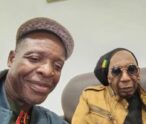
By Princess Eugene Majuru
Tradefair, Bulawayo, Zimbabwe ( News of The South) A wide-ranging interview between popular DJ Ollah and Zimbabwe’s Permanent Secretary for Information, Publicity and Broadcasting Services, Nick Mangwana, at the Zimbabwe International Trade Fair has sparked debate on social media. The discussion touched upon controversial topics from the recent independence day celebrations in Gokwe to government accountability and taxation.
One of the more colourful exchanges revolved around the heavy rainfall experienced during both the planned M31 protests and the Independence Day celebrations in Gokwe. Mangwana attributed the downpours to divine blessing, stating, “Vadzimu vatendera” – the ancestral spirits have accepted or blessed the occasion. He highlighted the irony of Gokwe, a region often plagued by drought, receiving such significant rainfall on Independence Day, framing it as a positive omen.
However, DJ Ollah pressed Mangwana on the optics of soldiers marching in waterlogged, muddy fields during the independence parade. Mangwana countered that Zimbabwean soldiers are accustomed to challenging terrain, citing their training in Nyanga and Kariba, and were equipped with appropriate boots for the conditions. He extended this to the police force, assuring the public that they too were suitably attired for the weather. Mangwana even claimed to have personally anticipated the rain based on the weather forecast and chosen his footwear accordingly.
Public concerns regarding the alleged US10 million spent on the Gokwe independence celebrations and the reportedly substandard stadium construction were also raised by DJ Ollah. Mangwana did not confirm the exact figure but explained that the budget covered various aspects, including school displays, air shows, and rehearsals. He attributed the installation of the bucket seats, some of which were allegedly falling apart before use, to the Ministry of Local Government. Other works, such as road construction, were said to have been handled by CMED and Public Works. Mangwana firmly denied any misuse of funds. He also took a swipe at social media, humorously suggesting its capacity to fabricate elaborate scenarios. He emphasized the significance of hosting the national event in Gokwe for the first time in 2025, allowing local children to experience a major celebration with ample food and drink, questioning why this positive development was being met with criticism.
Expanding on the decentralization of services, DJ Ollah inquired if citizens could soon obtain national identity documents from locations like Bikita. Mangwana affirmed the government’s commitment to making services more accessible outside Harare, echoing President Mnangagwa’s sentiment that “Harare was not Zimbabwe and Zimbabwe was not Harare.” He outlined a plan to rotate the independence celebrations across the country’s ten provinces over a decade. Furthermore, he confirmed that vital services like ID registration were now available in towns like Bikita, Mpandawana, and Zvishavane, reducing the need for citizens to travel to the capital.
Turning to government accountability, DJ Ollah directly asked Mangwana to identify areas where the government was lagging or failing. Mangwana pointed to the insufficient collection of taxes as a key challenge. He urged for more effective tax collection to fund essential services like road maintenance, education, and healthcare, acknowledging the difficulties in taxing a predominantly self-employed population engaged in hand-to-mouth survival. DJ Ollah highlighted the burden of the 2% tax on citizens, a claim Mangwana dismissed as insignificant, suggesting Zimbabweans should be paying more.
The state of the country’s roads was another point of contention. DJ Ollah questioned the poor maintenance despite the US$3 toll gate fees and the significant revenue generated from tourist routes like the Bulawayo and Victoria Falls roads. Mangwana explained that the Zimbabwe National Road Administration (ZINARA) collects these funds, retaining 10% for administration and salaries while distributing 90% to various road authorities, including local councils. He cited Harare City Council’s alleged failure to acquit previous funds as a reason for not receiving further disbursements, implying ZINARA was holding onto the allocated money.
The interview, characterised by DJ Ollah’s direct questioning and Mangwana’s often spirited defenses, has undoubtedly provided fodder for public discourse on a range of critical issues facing Zimbabwe. The contrasting perspectives on rainfall as a divine blessing versus the practical challenges of a muddy parade, alongside discussions on financial accountability and taxation, are likely to keep Zimbabweans talking long after the trade fair concludes.
See interview below:
Comments
About Author