

By Mary Doma.
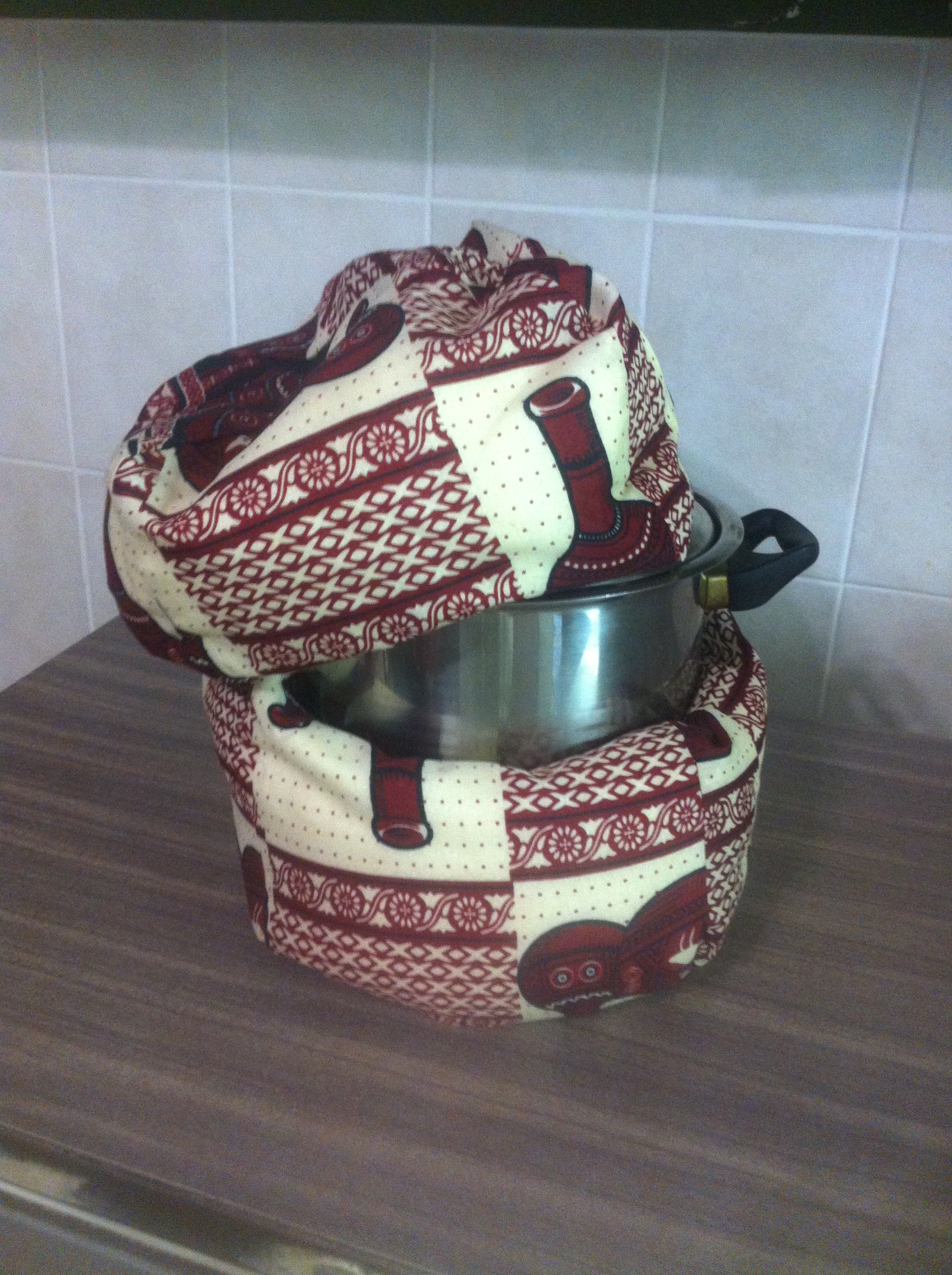
Katinka Ruhe, a Zimbabwean entrepreneur with a passion for the environment and for empowering women, came up with the idea for an electricity-free portable slow cooker, and she sewed the first prototype for what became the no fuel “cooking” bag.
Due to the continued power outages in Harare: Zimbabwe, residents continue exploring alternative sources of energy to save electricity.
“Hot Bags are an example of an alternative cooking method which is becoming more popular in a city afflicted by incessant power cuts,” she said.

Hot Bags, or retained-heat cookers, are insulated bags filled with heat retentive beads used to cook food using latent heat. The principle of retained-heat cooking is simple. In conventional cooking any heat applied to the pot after it reaches boiling temperature is merely replacing heat lost to the atmosphere from the pot.
In Hot Bags cooking food is brought to a boil, simmered for a few minutes depending on the particle size (5 minutes for rice or other grains, 15 minutes for large dry beans or whole potatoes), then put into the Hot Bag to continue cooking on its own.
” These are some time range for some food Rice and Porridge – 30 to 40 minutes , Pasta and Spaghetti – 2 hours , Samp – overnight or 8 to 10 hours , Braised Steak – 8 hours , Potatoes – 45 minutes (depending on the size of the potatoes , she said.
Since the insulated cooker prevents most of the heat in the food from escaping into the environment, no additional energy is needed to complete the cooking process. Food cooked in the Hot Bag normally takes two to three times longer than the normal stovetop cooking time. Food can be left in the Hot Bag until ready to serve and stays hot for hours.
Hot Bags manufacturer Katinka Ruhe explains, “Using Hot Bags not only saves energy but uses at least 25% less water. Water is retained in the food rather than evaporating.” She said you first need to add your heated ingredients and ensure that the Hot Bag is tightly sealed to prevent heat loss.
“Anyone who enjoys slow cooking will find Hot Bags perfect for roasts, stews, soups, rice, cereals and even beans,” said Ruhe. However, food does take longer to cook, so be prepared to plan ahead and start your preparations earlier.
Wood-fire cooking is the source of major social, economic, and environmental issues in Africa, says the entrepreneur.
“A typical woman will cook food in a pot over an open fire, and will have to monitor the pot for hours. Smoke is being inhaled by the women and children who tend the fires.”
She says that the bag saves about 30 percent of a family’s income when they make the change.
“They save water, the risk of disease and death from smoke inhalation is reduced,” she says. “Deforestation is minimized, and time is freed up to allow children to go back to school and women to seek employment.”
Ruhe said, “Hot Bags help to reduce the use of traditional fuels such as firewood.” Depending on the type and quantity of food being cooked, the use of a Hot Bag saves between 20% and 80% of the energy normally needed. The longer an item usually takes on a stovetop, the more fuel is saved by using the Hot Bag.
“Hot Bags prevent burning and overcooking food while nutrients and flavors are preserved,” she said. Heat-retention cooking is an age old tried and tested method that can be used to conserve energy not only during times of shortages, but anytime.
“Hot Bags has been used in our family for over 30 years. We use it on a daily basis and find an essential cooking aid in our kitchen.
“Not only does it help save electricity whilst preparing meals, but it also acts as a “warming drawer” when we have no power. It is even used to keep things cold when we don’t have access to a fridge, cooler box etc,”she said
Hot Bag are used for family braai’s, to cook the Christmas ham, to keep the morning porridge warm etc.
Katinka said the pattern has been handed down through the generations, swapped between her family members and modified to individual needs.
Zimbabwean’s deal with daily power cuts and Hot Bags is the perfect solution to cooking a family meal or keeping a meal warm when there is no power.
A small investment in a Hot Bag will pay dividends within a few weeks of use and will help during the hard economic times faced by Zimbabwean. Not only does it save on fuel costs, but also gives women time to either look after their families or pursue income generating projects.
Deforestation in rural areas is on the increase and Hot Bags can help alleviate this devastating trend.
News Of The South spoke to Ruhe who said that they manufacture three sizes, Small, Large and recently the Catering Size.
“Small bags will take an 8 or 10 inch pot. Large bags will take a 12 inch pot and the Catering Bag will take a catering sized pot, roasting pan or three 8 inch pots,” she said.
“The prices of the bags are as follows – Catering Bag $55, Large $30 Small $20, she added.
It is a very simple but very effective product. Instead of using your stove or gas to cook meals at length, all you do is prepare your meal as normal i.e. brown onions and meat, add vegetables and pour in liquid (stock or water) almost to the top of the pot.
Bring to boil on the stove and allow to boil for a minimum of 5 minutes. Transfer the pot into the base of the HOT BAG with a tea towel between the hot pot and Hot Bag, cover the pot with the Hot Bag lid and leave it. The food will then cook, very slowly on its own. Use your HOT BAG as a “warming drawer” as it keeps food warm for 8 to 10 hours.
You can not cook sadza in a hot bag as sadza needs to be constantly stirred.
The Hot Bag is made from polystyrene which is an excellent insulator. The food is cooked using the latent heat from the initial boiling or cooking. The hot bag can keep food hot or even cold for up to 8 hours (if the pot and bag is fully covered or undisturbed).
Simply wash the Hot Bag in warm soapy water, gently rubbing any stained areas. Hang the bag on a washing line in a warm sunny area and it will dry within a few hours.
Hot Bags can last for years and years, depending on the care taken with the bag. Hot Bag users must ensure that they place a towel or cloth between the base of the hot pot and the base of the hot bag as the heat from the hot pot could burn the bag.
These are an adaptation of a very old cooking method, which many historians claim originated in Scandinavia. This method of cooking has been in use as far back as the Second World War and the period of the Great Depression in America where cooking fuel was rationed. Today Harare residents have embraced this cooking method in an attempt to cope with the increasing lack of electricity.
Comments
About Author