

By Princess Eugene Majuru
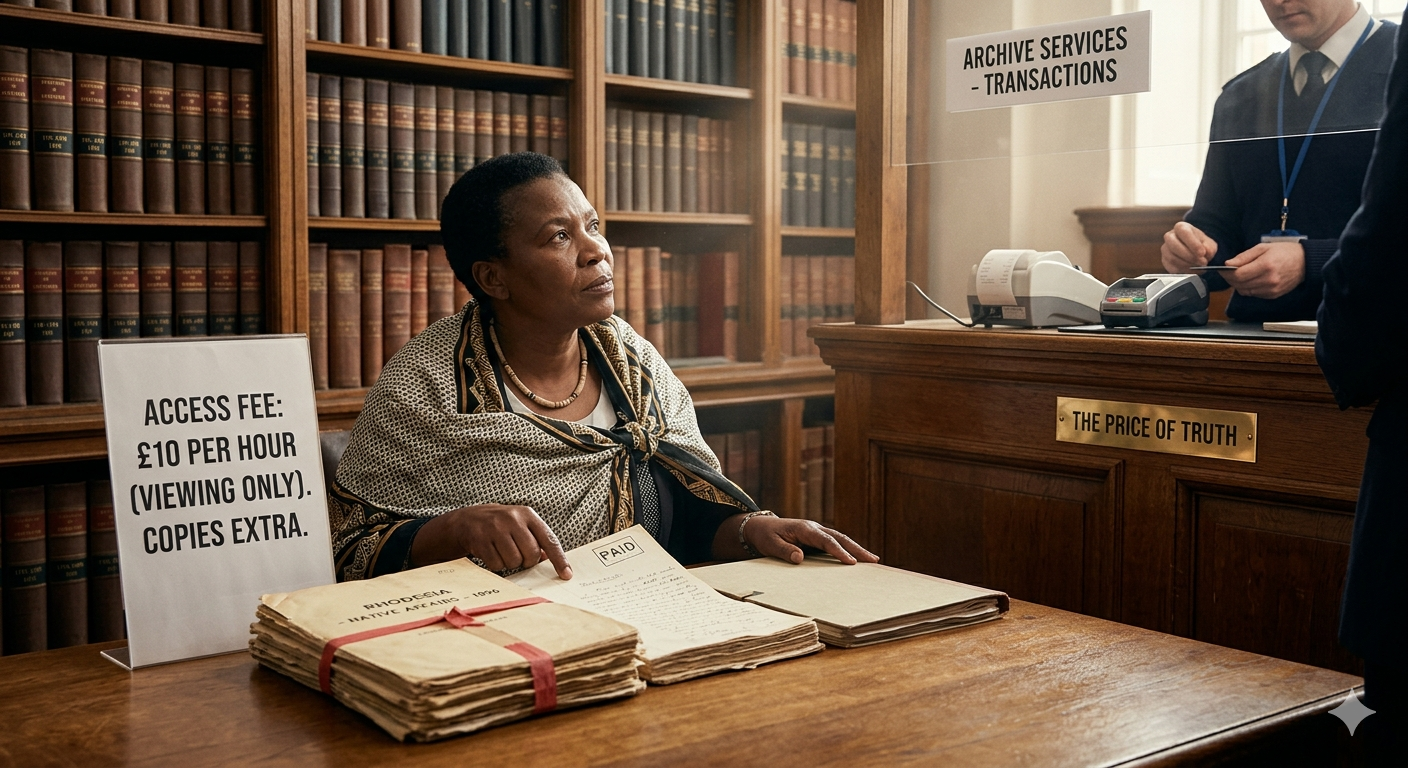
For many descendants of those who lived under colonial rule, the search for history is not a hobby—it is a quest for justice, identity, and the “untold truth.” However, a formidable wall often stands between the seekers and the records: the requirement to pay for access. When former colonizers charge fees for copies, digital access, or even the right to view archival documents, they transition from being “custodians of history” to “gatekeepers of a paywall.”
For Sovereign Custodians—traditional leaders, historians, and cultural archivists to be made to pay for colonial records it is a profound mark of disrespect. To treat a Sovereign Custodian or a victim of colonial history as a mere “customer” is to ignore the moral weight of the records in question.
The Gatekeeper’s Policy: Distance and Discouragement
Many archival policies currently in place were drafted by the former colonial powers themselves, often without the consultation of the nations or victims involved. These policies include:
The “Secret” Migrated Archives: For decades, thousands of colonial-era documents were kept in secret facilities, such as the UK Foreign Office’s repository at Hanslope Park. It was only through legal action—most notably by Kenyan Mau Mau veterans in 2011 and 2012—that the existence of these “migrated archives” was fully acknowledged.
Reproduction Fees: While many national archives offer free “viewing” in person, the cost of traveling to Europe is prohibitive. Digital copies or photocopies are often subject to per-page fees, effectively commodifying the evidence of historical trauma.
Breaching the Human Right to Truth
The practice of charging victims to access records of their own history arguably breaches several international human rights standards and ethical frameworks:
1. The Right to Know and the Principles Against Impunity
The UN Updated Set of Principles for the Protection and Promotion of Human Rights Through Action to Combat Impunity (2005) states that “the right to know implies that archives should be preserved” and that states have a “duty to remember.” Principle 14 explicitly emphasizes that access to archives is a right for victims to seek redress. Charging for this access creates a financial barrier to a fundamental right.
2. UNESCO Universal Declaration on Archives (2011)
Adopted on November 10, 2011, this declaration recognizes that archives “support democracy and human rights” and “preserve collective social memory.” It frames archives as a public good, not a commercial product.
3. Council of Europe Recommendation No. R (2000) 13
This recommendation, dated July 13, 2000, states that “access to public archives is a right” and that in a democratic system, this right should apply regardless of status. Crucially, Article 6 underlines that “freedom of access without charge… constitutes a basic principle.”
The Moral Failure of “Gatekeeping”
Morally, the argument is simple: the records of colonialism do not belong solely to the nations that wrote them; they belong to the people whose lives, lands, and cultures were documented—and often exploited—within them. When a Sovereign Custodian of a royal lineage, such as a descendant of King Mbari, is asked to pay to see the records of their own ancestors’ displacement or the laws that governed their clan, the “gatekeeper” is essentially selling back a stolen heritage.
Victims of colonialism are not customers. They are stakeholders in a shared, albeit painful, history. To move toward true reconciliation, former colonial powers must move beyond the “gatekeeper” mentality. This requires:
Abolishing fees for descendants and Sovereign Custodians seeking colonial records.
Proactive digitisation and free sharing of records with the countries of origin.
Co-management of archives with the communities they describe.
The truth should never be hidden behind a price tag, especially when that price is being paid by the very people from whom the truth was originally taken.
#DecolonizeHistory decolonisation #africanculture african #africanhistory #highlight
Comments
About Author