

By Princess Eugene Majuru
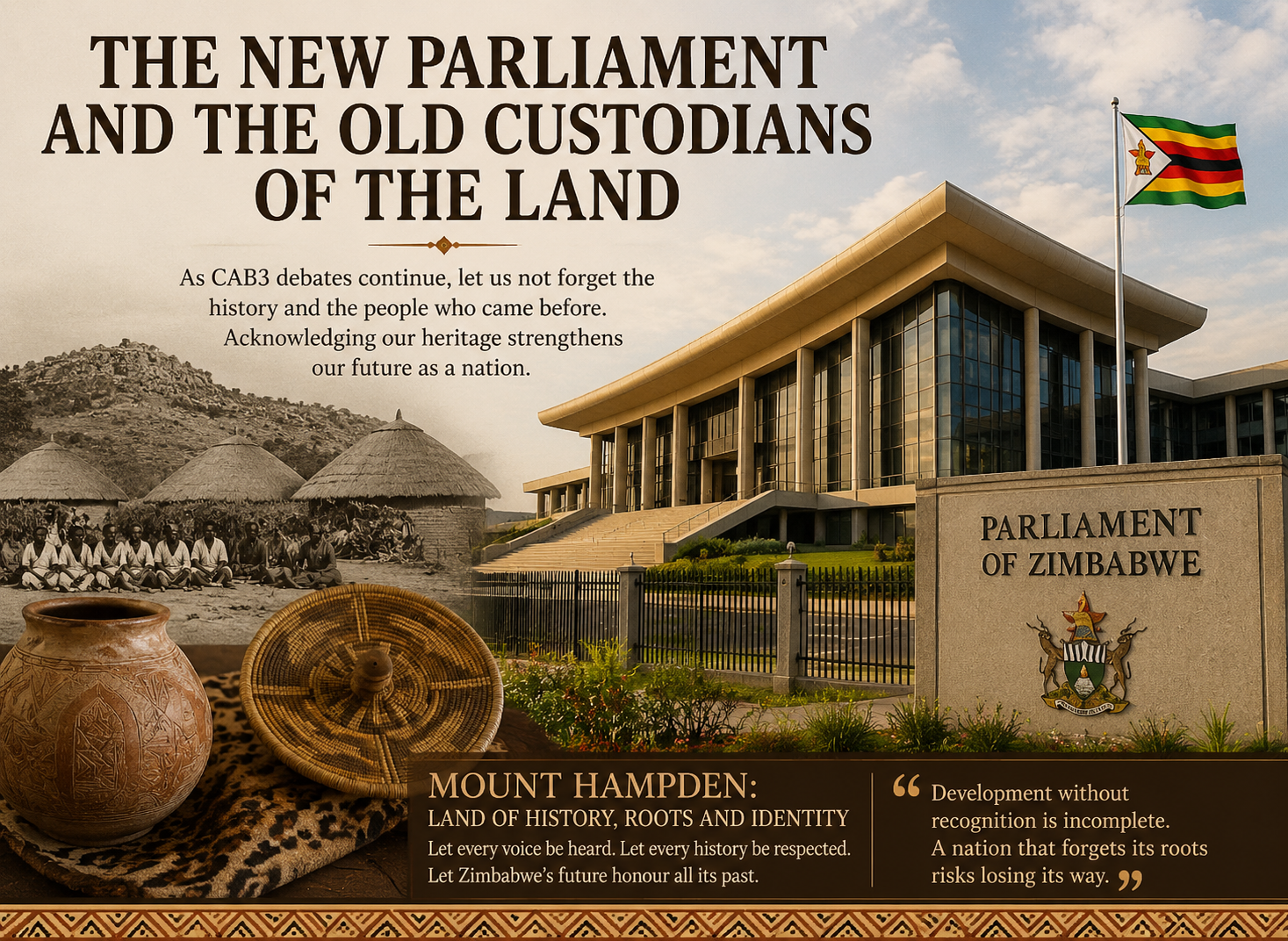
As Zimbabwe’s lawmakers debate Constitution Amendment Bill No. 3 (CAB3) within the imposing chambers of the new Parliament Building at Mount Hampden, an important question remains largely unasked: what is the historical significance of the land on which these deliberations are taking place?
The new Parliament is more than a modern architectural landmark. It stands on land that carries centuries of history, memory and cultural significance. Long before the rise of modern political institutions, before colonial occupation and before the establishment of Harare as Zimbabwe’s capital city, these lands were home to indigenous communities whose descendants remain part of the nation’s story today.
Among those communities are the Mbari people, whose ancestral territory extends across present-day Harare, Mount Hampden, Mazowe and Concession. Their history is inseparable from the landscape upon which the country’s highest legislative institution now stands. As CAB3 generates national debate about constitutional change, governance and the future direction of the state, it also presents an opportunity to reflect on the relationship between modern institutions and historical communities.
Parliament is often described as the house of the people. If that is true, then it must also be a place where the nation’s history is respected and acknowledged. Development and modernization should not come at the expense of historical memory. The construction of a new Parliament on ancestral land should encourage conversations about heritage, identity and inclusion. This is not an argument against progress. Nations evolve, cities expand and institutions grow. Rather, it is an argument for recognition. Modern Zimbabwe did not emerge from a vacuum. It was built upon the foundations laid by generations of people who lived, governed and preserved these lands long before the arrival of contemporary political structures.
The debate surrounding CAB3 has understandably focused on legal and political questions. Yet there is another dimension worth considering. Who is included in the national conversation about Zimbabwe’s future? Are communities with deep historical ties to the land being heard? Are traditional histories being preserved as the country charts its path forward?
The absence of formal recognition of certain traditional institutions does not erase the existence of the communities they represent. Heritage survives through people, memory and culture. The descendants of the original custodians of the land continue to carry that heritage, even when their voices are not prominently featured in public debates. Mount Hampden now symbolizes the future of Zimbabwean governance. But it should also remind us of the past. The ground beneath Parliament is not merely real estate; it is part of a living historical landscape that predates the modern state.
As legislators discuss constitutional amendments and national priorities, there is value in remembering that democracy is strengthened when it embraces all voices—not only political voices, but historical, cultural and traditional ones as well. The new Parliament may represent the future, but the old custodians of the land remain part of Zimbabwe’s enduring story. Their history deserves recognition, and their voice deserves a place in the national conversation.
Princess Eugene Majuru
Descendant of the Harare Royal Family
Mbari Clan
Author and Cultural Heritage Advocate
Sovereign Custodian of Mbari Clan
Comments
About Author