


By Correspondent
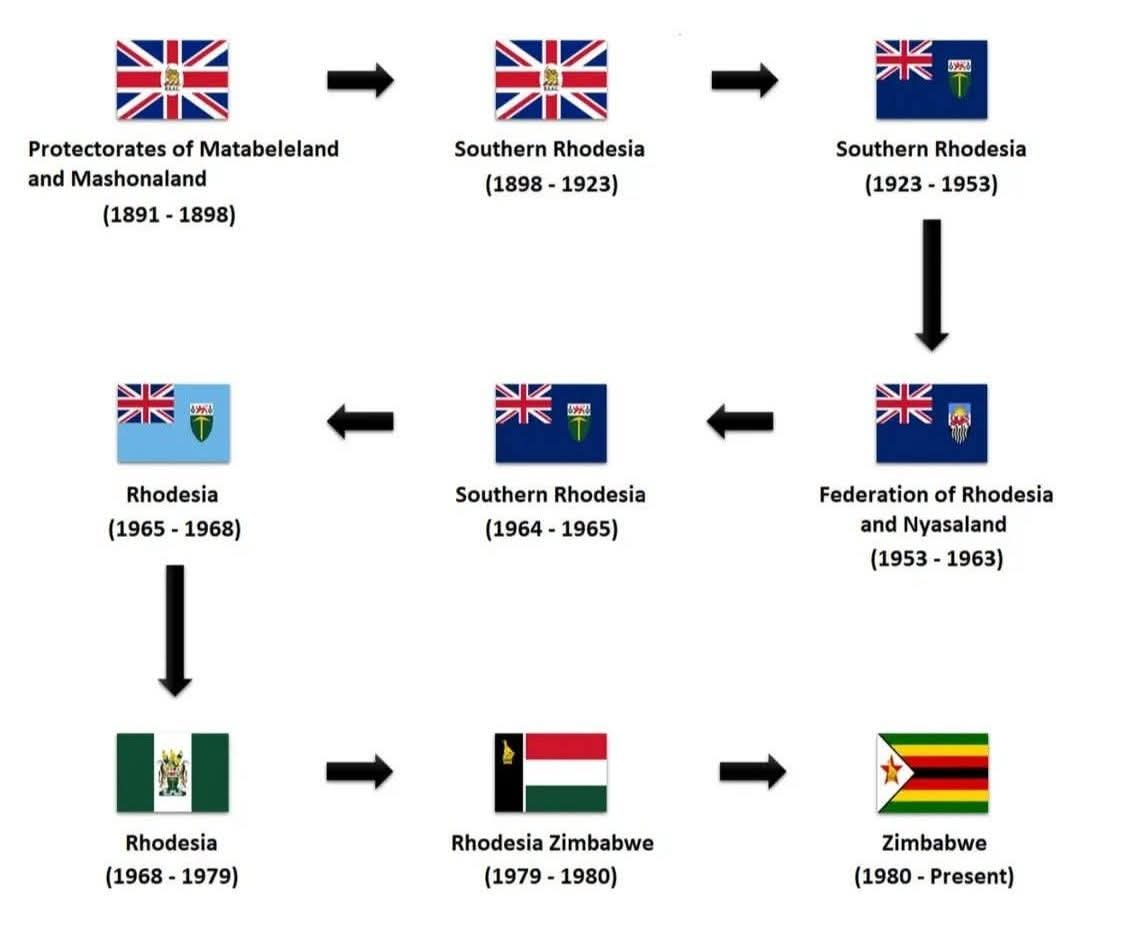
The year 1979 represents a brief, intense, and largely forgotten chapter in Zimbabwe’s journey to majority rule. It was a time when the white minority regime, desperately clinging to power amidst a brutal guerrilla war, enacted a constitutional and cosmetic change that produced the short-lived state of Zimbabwe-Rhodesia and its unique, forgotten flag.
This flag—a Pan-African tapestry of green, yellow, red, and black—flew for only eight months, from June to December 1979, serving as a powerful symbol of political illusion, compromise, and the ultimate failure of the Internal Settlement.
The “Internal Settlement” and Constitutional Deception
The creation of Zimbabwe-Rhodesia was the direct result of the 1978 Internal Settlement signed between Rhodesian Prime Minister Ian Smith and moderate black nationalist leaders, primarily Bishop Abel Muzorewa, leader of the United African National Council (UANC).
The core scenario was a compromise born of exhaustion:
Rhodesia’s Desperation: The Rhodesian Front government was severely weakened by the escalating guerrilla war (The Chimurenga/Bush War) and crippling international sanctions. Smith needed a deal to legitimize the state and stop the fighting.
Muzorewa’s Opportunity: Moderate leaders, excluded from the liberation war, saw an opportunity for political power.
The Result: The settlement created a bicameral parliament with a black majority, and Muzorewa became the first Prime Minister of the new state. Crucially, however, the constitution retained control over the military, police, judiciary, and civil service—the true levers of power—in the hands of the white minority. The flag changed, but the power structure did not.
The Significance of the Flag and the Failure of Law
The Zimbabwe-Rhodesia flag, with its Pan-African colors, was a cosmetic concession. Its design was meant to project an image of a new, multiracial state committed to African identity. However, its brief existence was doomed because the settlement failed to address two fundamental legal and political realities:
1. International Non-Recognition and the Unfinished Struggle
The world, led by the United Nations and the front-line African states, universally dismissed the new state. This was not viewed as genuine decolonization, but as an attempt to preserve white privilege through constitutional engineering.
The liberation movements—ZANU (under Robert Mugabe) and ZAPU (under Joshua Nkomo), united under the Patriotic Front—refused to recognize the new government and intensified the war. They demanded that power be transferred through a negotiated settlement involving all parties, not a one-sided internal deal. This external pressure was key: the new state was never formally admitted to the UN and sanctions remained in place.
2. The Legacy of the Law: The 1979 Constitution
The short-lived constitution of Zimbabwe-Rhodesia was the instrument of its own failure. It was designed to maintain white veto power through mechanisms that ensured certain key positions and a disproportionate number of parliamentary seats were reserved for whites. This legal framework confirmed that the Internal Settlement was a transition of appearance, not substance.
The Final Transition: Lancaster House and the End of an Era
The situation was resolved only when the United Kingdom intervened, convening all parties—Smith’s government, Muzorewa’s UANC, and the Patriotic Front—at the Lancaster House Conference in London in late 1979.
The resulting Lancaster House Agreement led to the dissolution of the Zimbabwe-Rhodesia state. The country temporarily reverted to being a British colony under a Governor until fresh, non-racial elections could be held. This marked the end of the short-lived 1979 flag.
On 18 April 1980, with the official granting of independence, the current Flag of Zimbabwe—with its iconic red star and the Zimbabwe Bird—was raised, symbolizing genuine and full majority rule.
The Zimbabwe-Rhodesia flag, therefore, stands as a critical reminder of the tension between law (the cosmetic constitutional change) and political reality (the demand for genuine majority rule). It symbolizes a moment when the price of continued conflict became too high, forcing a failed compromise before the ultimate, internationally-recognized freedom could be won.
Comments
About Author


