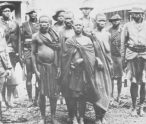
London, England (News Of The South) – The wooden drawers of European museums still hold more than curiosities: they hold people. In his persistent and often incendiary interventions over the past five years, Professor Dan Hicks — curator at the Pitt Rivers Museum and professor of contemporary archaeology at Oxford — has argued that Britain’s museums are sitting on an ossuary of stolen lives and stories. He demands not only the repatriation of carved bronzes and ritual objects, but the honest accounting and return of human remains — “the bones” — taken during colonial campaigns and swept into the cabinets of empire. What follows is an exploration of Hicks’s arguments, the public debate he has fired, and why the question of ancestral remains remains one of the most morally urgent and logistically fraught issues facing museums today.
“Necrography”: naming what’s been done
Hicks has used the term necrography — an insistently forensic phrase — to describe how colonial collecting turned living people into museum objects: catalogued, boxed and written into silence. In essays and chapters collected around his book The Brutish Museums, and in related papers, Hicks maps a pattern: violent annexation on the ground, bureaucratic processing in institutions, and a persistent refusal to treat the dead as relatives rather than “specimens.” He explicitly calls for museums to open their storerooms and publish what they hold so descendants can know whether their ancestors are being kept far from home.
That demand for transparency is not rhetorical. Hicks argues that many institutions simply do not know the full provenance of the human remains in their collections — neither the circumstances by which those remains entered the museums nor the communities to which they once belonged — and that this ignorance is a structural problem demanding radical institutional reform. The remedy he proposes combines scholarly research, community-led investigation, and legal/political mechanisms for return.
A wider canvas: from Benin to bone
Hicks rose to wider public attention through his forensic retelling of the Benin raids of 1897 and the dispersal of the Benin Bronzes. That episode is the archetype he returns to: a violent imperial expedition that looted court art and deposited it across Britain and Europe. He uses Benin as a frame to show how the politics of collecting were inseparable from military and economic violence — and how museums today continue to inherit that violence if they maintain possession without meaningful redress.
But Hicks’s critique goes further than bronzes. In essays and lectures he has broadened the conversation to human remains — skulls, mummies, skeletal collections — arguing these are often “objects of knowledge” created by colonial science and anthropology as much as by conquest. He names the particular indignity: ancestors displayed or stored as if their personhood had been erased. The solution, he says, is not only restitution but a fundamental redefinition of what museums are for: sites of conscience rather than cabinets of conquest.
Voices from Africa — and the glacial pace of change
Calls for return have come for decades from African politicians, museum directors and descendant communities. Recent years have brought high-profile repatriations (or agreements to repatriate) of prominent objects, and increased political pressure on institutions such as the British Museum and Oxford’s museums to move faster. Yet Hicks and others point out that when it comes to human remains the movement is far slower and fraught with additional ethical, legal and logistical complications — and, critics say, too often avoidant.
Part of the resistance is practical: records are incomplete, scientific analyses have commingled remains, and international repatriation law is patchy. Part of it is ideological: many institutions treat their collections as research resources or public property that must be preserved under their care. Hicks’s retort is structural — these are not neutral custodial problems but the afterlife of imperial relations of power. He urges museums to reframe their responsibilities: to accept that provenance research and repatriation are not optional add-ons but central ethical duties.
What a reckoning would look like
Hicks proposes a mix of measures. First, mandatory, public inventories of human remains and clearer provenance data — putting the contents of storerooms into the light. Second, co-designed processes with claimant communities that accept oral histories and local claims alongside archival research. Third, legal and institutional mechanisms to expedite transfers when provenance and claims are clear; and when return is not immediately feasible, long-term loans, shared curation, and joint-research partnerships that rebalance authority. Taken together, these steps aim to move museums from gatekeepers of the past to partners in reparative futures.
Objections — and why they matter
Critics have pushed back at Hicks on several fronts. Some academics question parts of his historical narrative or his characterization of specific events — for example, debates have erupted over the interpretation of some episodes from Benin history. Others worry about the loss to science and public education if remains are removed entirely. Still others fear a slippery-slope: today bones, tomorrow entire collections. These debates are not trivial; they shape public opinion and government willingness to legislate. But Hicks’s central moral claim — that people and communities deserve to know whether their dead are in foreign boxes and to have a say in what happens next — is difficult to refute on ethical grounds.
Museums, memory and moving forward
If museums accept Hicks’s framing, the work ahead is institutional, painstaking and, crucially, political. It will require funding for provenance research, legal reforms for cross-border transfers, sensitive consultation practices, and a shift in curatorial training away from a sole focus on objects to a practice that recognizes people behind those objects. As Hicks and his interlocutors keep reminding readers, repatriation is not nostalgia; it is a step in making historical injustice legible and repairable.
Conclusion: what “return the bones” asks of us
“Return the bones” is both a literal demand and a metaphor for returning dignity. Dan Hicks has made the case that Europe’s museums must reckon with the human remnants of empire — not as inert data points, but as relations to be restored. Whether British museums will respond with the speed and humility the moment requires remains open. What is not in doubt is that continuing to hide ancestors in storerooms under labels and accession numbers is a moral choice — and one that, increasingly, the public and descendant communities are refusing to accept.
Key sources and further reading
-
Dan Hicks, The Brutish Museums: The Benin Bronzes, Colonial Violence and Cultural Restitution. , “Necrography: Death-Writing in the Colonial Museum” (British Art Studies)
-
Interview/features and essays on restitution and the Benin Bronzes (The Art Newspaper; The Guardian).