

By Maxwell Chivasa And Violet Gondah.
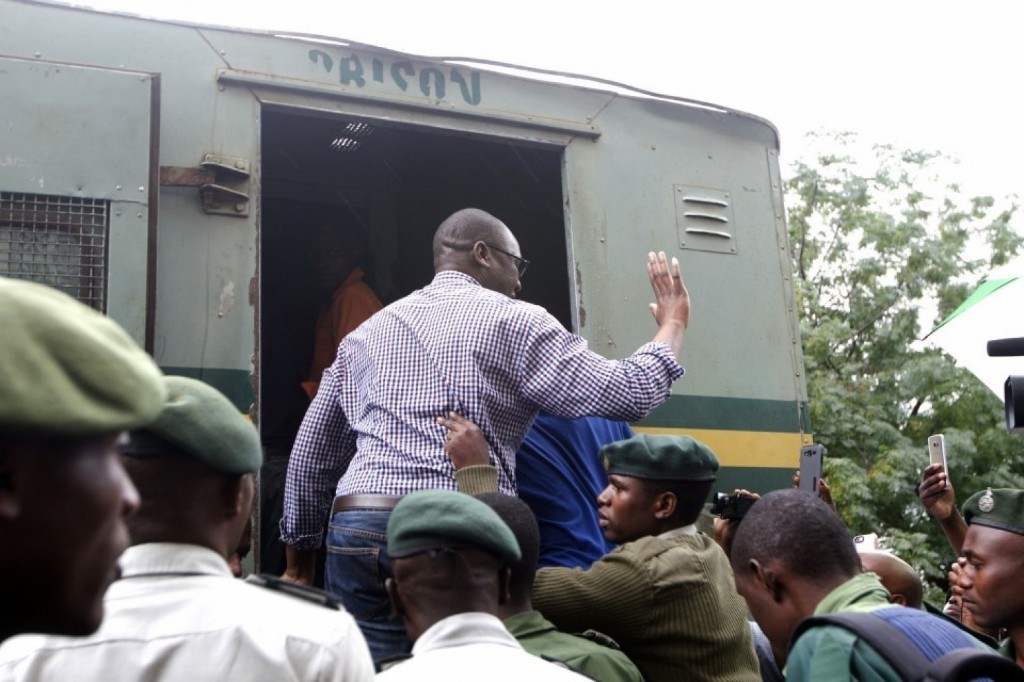
London, England. (News of The South ) – Pastor Evan Mawarire was arrested Monday while praying for a better future for medical students who were protesting against a 35% increase on their fees.
With the ruling party in charge of the country for the past 37 years, the opposition might be forgiven for election fatigue and general lack of different things.
One of the opposition MPs Priscilla Misihairabwi-Mushonga was even critical of too much ambition but lacking direction and strategy.
In an interview with Violet Gonda for the Hot Seat programme with a wider viewing on YouTube she said:
“I’m getting so sick of it, when opposition leaders meet, what is on the agenda? It is coalition for leadership.
“It is not coalition for strategy, it is not coalition for thinking through messages, it is coalition for leadership.
“And, we are stuck in a rut, that everything and anything is talking about who is going to lead this coalition; how are we going to divide these seats when we get into a coalition.”
The opposition seems to experience problems with recruiting the right candidates.
Some candidates lacked focus.
“Even people that I’ve never heard of, somebody who has never even run for council or local authority, or done anything at a community level, is beginning to believe that because they woke up one morning and called themselves a president of a political party, therefore they are going to be sitting somewhere where a cake is going to be cut up and they will be given their own three seats, or two seats or one seat, or whatever it is,” she laments.
Although MDC-T had spent much time campaigning in the rural areas of Zimbabwe, Afrobarometer figures showed opposition support was not healthy in rural areas, “things don’t look so good”, she said.
In 2013 the opposition dismissed the Afrobarometer research and even accused them of being sponsored by ZanuPF and therefore did not take them seriously. Now the opposition had learnt a lesson.
“We should be looking at those figures and going through those polls. I have not heard of any political party that is looking at those Afrobarometer numbers,” she said.
The rural vote was estimated at about 70% of the voters and the opposition had not made much inroads there.
A strategy to expand the party’s membership base had been launched focusing on women.
“We are working on this Women’s Election Convergence I’ve been spending a lot of time looking at the studies and census figures.
“One of the problems that we have had in the urban areas, whilst we have had some sort of freedom and less of intimidation, women in urban areas don’t come out as much to vote.”
She said 93% of men were involved in the elections in the urban areas compared to 63% of women.
“You can either raise the numbers of your women in urban areas and here I’m talking about a Presidential election. Let’s assume that you are wanting to hit your over 2 million, because we know that Mugabe won by 2.1 in the 2013 election.
“So for all intents and purposes we should be saying we should be hitting 3 million. So if you are going to shift those figures then we need to up the number of women who are in urban areas who are not going to register to vote, because there are more men that are registering than women.
She said in the rural areas, research had shown that 92% of women registered and voted, compared to 90%.
There were many issues to deal with among rural communities. Who is likely to be influenced by the issues of patronage, government distribution of seeds and maize food, and the heads of households and communities played a major part in decision making at election time.
“Are there more men or are there more women? And what are the issues that drive these women to go and vote for ZANU PF?” she said.
Misihairabwi-Mushonga has raised fears of political intimidation and violence in Zimbabwe’s rural areas during next year’s general elections.
She believes women had a political constituency in Zimbabwe.
This has always been known that the levels of intimidation and the levels of violence were higher in rural areas, with women being the weakest point.
“Yes, they (women) are a political constituency, but if you define them as a political constituency, you then need to engage with them on the basis of what it is that drives that woman to the polling station,” she said.
Opposition political parties should understand what was driving people to vote or why 45% of the vote trusted Mugabe.
“It doesn’t help for you to sit there and say they must be lying. They are not because they have done it in 2013 and it came out exactly as predicted,” she said.
Women’s Election Convergence met last week in Bulawayo with leaders from the opposition political parties such as Thokozani Khupe, Lucia Matibenga and Joice Mujuru. It was important to get “women onto the voters’ register and we have given ourselves a target of 2 million.”
They hope to achieve this by getting women from political parties who are already political activists. They want to come up with 20 000 women and each of these mobilises 100 women to hit the 2 million target.
“I’ve got something like 250 friends on my phone that I chat with.
“So what we’re asking you is just do woman to woman with the person that you know. So this is the person that you will follow up and see that they have gone to register, you will follow up and see that they have gone to vote, because they have some loyalty, they owe you something.”
She had personally reached 100 women and they were able to raise their fears.
She said the Women’s Election Convergence would be launching a Hotline to report violations, beatings, houses burnt, and any criminal offences so people have a sense of security.
The police, the Zimbabwe Electoral Commission, the Gender Commission attended their meetings in order to establish relationships and be able to raise issues from the people.
Some voters lacked faith in the candidates who did not show up before and during election campaigns.
“People believe that seats are going to be given to them. If we start saying leadership is going to be associated with what you have brought on the table, people will go out and get people excited,” she said.
ZanuPF conducted primary elections,
but some of the opposition leaders were opposed to primary elections. Electoral power was among communities and they must choose their candidate to represent them in Parliament.
Misihairabwi-Mushonga said:
” If I had my way, primary elections would happen right from the top that is
from the presidential candidate right up to the councillors.”
She was working on initiatives to encourage women participation in elections such as HerVote and SheVote.
They would launch a programme called Mother-Daughter, to ensure that mothers and daughters join politics. It had been noted that in some instances, daughters were active in politics but mothers were not, or vice versa.
As one of the negotiators before the GNU, Misihairabwi-Mushonga said
they discussed the constitution,
setting up of independent institutions, for example, and ensuring free and fair elections, the whole question about ZEC formulation and changes to the Electoral Act to align it to the constitution.
“But I am not a believer in that we will see any electoral reform and I think it’s time in our minds and in our messages, as opposition political parties, that we begin to tell ourselves that this is almost going to be like the 2000 elections, it’s going to be like 2008 elections where we had no reforms, when things were bad and yet we beat ZANU PF,” she said.
She believes that the problem was not whether they could win under these circumstances but when they do win how do they make sure that they can take over power.
And that was the conversation that should be happening behind the scenes. It was a major issue of concern.
“Do we do a Gambia? What do we do? But, winning an election, for me, is not necessarily directly linked to electoral reform.
“So we need to shift the narrative. There are not going to be any electoral reforms. We are dealing with what’s on the ground and we can win this election if we change the way we do business,”she said.
She said that the opposition should be strategic and not concentrate on forming coalition leadership. The reasoning being that if ZANU PF wanted to infiltrate you they would have done so already.
Misihairabwi-Mushonga said: “You can have coalitions now but coalitions to discuss strategy, not coalitions to discuss leadership.
“Trust me, and I’m willing to do a community survey, if you were to come up with a person you say is a leader, or a person that you are putting in constituencies right now and you think you are going to do it.
“I can assure you that thing will be so messed up by the time you go to elections. If you think you can organise a coalition by having 20 political parties sitting around the table, and you think you can discuss in that kind of setting with parties that are breaking up every other minute, with little parties that are going to be sponsored by the system, and you seriously think that you can discuss coalition building in a room with 20 people? Even with four political parties – it’s an impossibility.”
She said dealing with issues of leadership, you will have to deal with the issue of who mediates that process. It was not going to happen. The important issue was for people go and out register.The electorate needed to trust the opposition. They would not trust the opposition because there was now have one leader.
Perhaps with regret she realised they were unable to push for little or small reforms during the unity government.
“You think you can overhaul a whole system? How are you going to do it? Are you going to do a coup? How? For me there was no basis to even entertain that suggestion because it is so far-fetched and it is not going to happen.
“That’s why some of us did not even give it any time of day because one knows it will be impossible. I am not a believer in this argument that without reforms you can’t win an election.
“We have won elections without reforms when things were even worse than they are right now,” said Misihairabwi-Mushonga.
What do the opposition do after a win? A reality check ought to have taken place. “What is it that we should have done in 2008 to make sure that that election, which had been won, became a reality? We were not organised, we didn’t think about it, how do we vote and how do we protect that vote, that is the question.
Asked whether she was running in the 2018 elections she said she had no idea
“but my priority right now is to make sure that whether I run or I don’t run, I want to make sure that ZANU PF is out of power”.
About Author