


By Taffy Nyawanza.
The televised address by President Mugabe had the added drama of coming later than its scheduled time. In the time leading to its start, the social media space was alight with conclusions drawn, political obituaries written, and forensic analysis about the post-Mugabe terrain and the various roles of key players.
Footage of the extraordinary scenes of a parallel process of the Central Committee of the ZANU PF party streamed in. Obert Moyo, the erstwhile ‘obedient son’ of president Mugabe chaired a session to expel the president from a party which he had dominated for close to five decades. Patrick Chinamasa, the party’s legal secretary, summarised the resolutions. Robert Mugabe – expelled. Grace Mugabe – expelled. And the rest of what is now being referred to as ‘the cabal’ by their names. The room rocked to ‘Kutonga kwaro’, a song which prophesied the rise and rise of Emmerson Mnangagwa, the newly installed First Secretary of the ruling party. The only thing standing between him and the keys to the State House was the expected resignation of the incumbent.
On the fringes of the meeting, Christopher Mutsvangwa, the live-wire war veterans’ leader and agitator, gave a running commentary. He is the man who spews big English words without any effort at all.
‘President Mugabe is finished’, he declared, a large grin splitting his jowly face. ‘He will have to resign now’.
And so it appeared that the dots were connecting, the script reaching denouement.
And so the ZBC Outside Broadcasting trucks gathered at State House. The world media tuned in and warned of imminent ‘breaking news’. The most anticipated resignation speech since Richard Nixon’s of 8 August 1975 was about to be given.
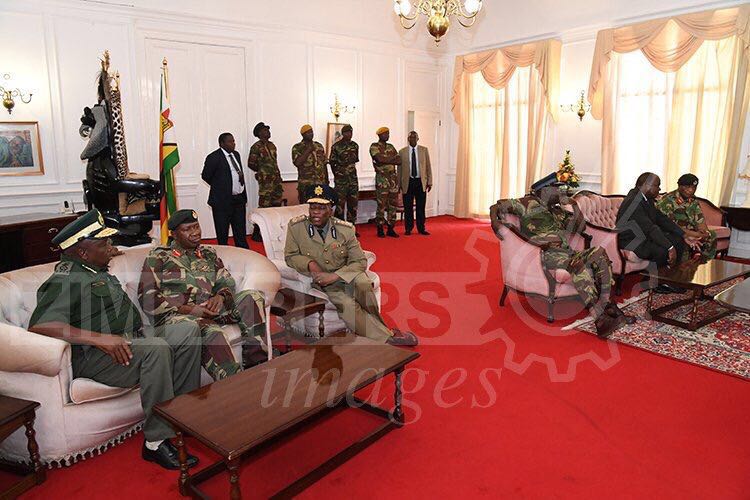
Mbira music played as the camera panned in. The military generals, mostly in fatigues, stood and waited. General Constantino Chiwenga looked as fierce as ever and flexed his huge arms. Next to him was Police Commissioner Augustine Chihuri who looked visibly shrunken, no doubt ravaged by the experience of his ongoing house arrest. He had a military tie in his police tunics, to remind everyone that he belongs among generals. Next came Lt Gen Philip Valerio Sibanda, the imperious looking Commander of the national army. Next to him stood the president’s relative, Air Marshal Perence Shiri of the Air Force, the tallest of the generals and who clearly looked in rude health, contrary to the explanation offered for his absence from the coup plotters’ press conference of 13 November. Next to him, the portly Rt Major General Paradzayi Zimondi scratched his beardless chin. Last, and in a suit, stood the civilian head of the CIO. He chewed his lower lip furiously, looking like he might bolt at any moment.
All of them craned their necks and looked around and shifted and held their hands behind their backs and waited.
At last, the president shuffled in, dressed in a dark scotch suit and burgundy tie.
‘Let me start by greeting’, he said and laughed nervously. General Chiwenga gripped the president’s frail hand and shook it vigorously. He did not offer a salute. The others did, with Chihuri, Shiri and Zimondi giving the smartest salutes. Zimondi almost fell forward in his enthusiastic show of loyalty.
Then they stood back in their positions, ranged to the president’s right.
To the left stood the large black-clad priest Father Fidelis Mukonori SJ, the Roman Catholic priest and confessor to the president. Next to him was Rt Brig Happyton Bonyongwe, lately of the CIO and now the Justice minister. Then came Misheck Sibanda the cabinet secretary, and finally George Charamba, the president’s press secretary. This appeared to be the president’s negotiating team.
The president walked slowly to a table covered in silk cloth and which looked like a draped coffin. He motioned to the generals and they sat down. Someone stepped forward and nervously adjusted the ZBC microphone on the table, clasping his hands in front of him and bowing repeatedly and giving us a glimpse of how the president is with those who serve him.
The president himself looked a diminished man, the smallest man in the room, behind him four flags of state which were arranged in front of a fireplace and above it, the president’s portrait. His head looked more denuded of hair than ever before.
‘Are all the journalists here? Ready?’, the president asked.
The lackey nodded and withdrew.
‘Fellow Zimbabweans’, the president began, hunching over his papers and somehow managing a firm and authoritative voice.
‘I address you tonight on the back of a meeting I had today with the nation’s security forces command element’.
He spoke deliberately and rolled his tongue around the big words which peppered the speech; ‘veritable’, ‘a peaceably disposed people with a givenness to expressing ourselves with restraint’, ‘vicissitudes’, ‘comported’, ‘collegiality’, ‘redound’, ‘epochal’ and so on.
It was a stumbling performance in parts but he ploughed through it.
He mentioned ‘law and order’ the most. He talked about an operation by the military. He said it ‘…did not amount to a threat to our cherished constitutional order. Nor was it a challenge to my authority as head of state and government. Not even as Commander in Chief of the Defence Forces’, he intoned, sliding inexorably into the bizarre.
‘I am happy that … the pillars of state remained functional’, he declared.
The speech went on. And on. And then on. But there was no sign of the ‘r’ word anywhere.
Rather, he talked of ‘a well defined hierarchy and succession’ in the party. He acknowledged problems in party and government and offered to change things and turn the economy around.
Ironically, he reminded the nations of Zimbabwe’s ‘tradition of resistance’ and said it was our ‘collective legacy’. In the unfolding drama of the last few days, you almost expected the General to jump up and say ‘Sir, that is why we have clipped your wings. We have resisted you’.
The moment passed.
Then the president dropped a nuke.
‘The Congress is due in a few weeks from now. I will preside over its processes…’.
He mentioned recent developments which have happened in the party, alluding to his political decapitation by the Central Committee and, in an extraordinary throw of the dice, offered comprehensive reform.
He asked the nation to put ‘shoulder to the wheel amidst the promising agricultural season already upon us’. He reminded the nation of the war time mantra ‘iwe neni tine basa’.
This was followed by a very rare word to stumble out of the mouth of this ancient pugilist.
‘Sorry’, he said.
But it was not an apology for his misrule. Or for his refusal to vacate office. It was for fluffing his lines on live television. It had been so bad that at times, General Chiwenga had leant in to help with the order of the papers as he stumbled over them.
Then, ‘Tatenda. Asante Sana. Siyabonga’.
The collective jaw of the nation dropped.
‘Ok thanks’, he said and shuffled up. His police aide saluted him.
Everyone stood up alongside.
It was the end which was not the end and incredibly, in defiance of all bets placed tonight, this wily ninety-three year old fox remains president of our republic.
About Author


