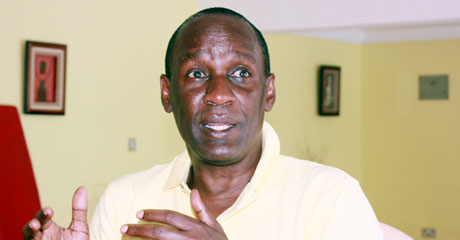


Uganda. – Mr Mukula says the leadership contest in the National Resistance (NRM) Party of which he is vice chairman for eastern region, is viewed by members as fundamental and should be looked at beyond President Museveni and Mr Amama Mbabazi, because Uganda is bigger than any of the two. Throughout the interview, Mr Mukula stresses that it is important to retire from politics when one is still loved and popular:
Q: You recently announced in Soroti District that you are quitting active politics due to ill health. Besides that, what else explains your decision not to contest for the Soroti Municipality parliamentary seat in the 2016 elections?
Well, I have no other reason that could have compelled me to this other than a personal decision not to run. I have not been coerced, I have not been intimidated, I am not under any ill health, I do not have (high blood) pressure, diabetes, HIV/Aids, I am mentally alert and physically fit. At the age of 58 now, it’s a prime time now for me to move to the private sector.
It takes about 10 years to build a strong foundation in business. I came from the private sector in 1996 when I first got to Parliament, the Sixth Parliament. At that time I came with a strong foundation. I had five aero planes in one of my companies and I was doing very well. I came to serve the people. My commitment was to serve the people. As a patriot, a nationalist and a pan Africanist. I have given my constituency my best. The time has come now to bid the constituency farewell when am still very popular.
Q: When did you decided to quit active politics?
It is something I decided three years ago and I have consulted deeply, first of all within my family, within the leadership of the party (NRM), at the highest level of the President and a number of colleagues at the local level, district level, constituency level. It has been a very difficult decision but I think it is the right time for me to go.
Q: What was the reaction of your family to your decision to quit politics?
They were very excited. They realised that for the first time I would be available to them. I have been married to the people of Soroti Municipality and Uganda. I never had the opportunity to even take my children to school in the mornings, pick them after lessons or even time to attend their school games. You can imagine what it feels like as a parent not to have time for your children to take them to even attend games, even graduations.
From the time they went to Primary One up to the time they finished education I never had time for them. With my wife equally, we were not having time even for dinner or even to take her out. But now I have enough time to take the family out. I have enough time to relate with my mother, and siblings. To me this is the time now to give back to the family.
Q: And what was the reaction of the President to your decision to quit politics?
Many people, including the President did not believe it. It was like a surprise. I have had discussions recently with senior colleagues within the party and thought that maybe something could have provoked me to that position. But I have been able to comfort them that it is out of goodwill. Serving a constituency is a very big challenge. It is a big sacrifice.
You give everything, even beyond your own resources to the constituency. It is not a job, it is a sacrifice to society and there is no salary that can pay me for the services that I have rendered to my people. Those who go into politics expecting to make money out of politics are in the wrong profession because politics is not about money. It is not about a job. It is about service to your country.
There must be life after Parliament. There must be life after politics. I do not want to image that somebody would really make politics a permanent engagement. I got things to do outside Parliament that will help the country.
Q: Isn’t your decision to quit politics a rash?
I don’t think it is a rash decision on my part. The way I perceive it, there is nothing more I can add to Soroti Municipality but the good thing about it is that I will remain within my party, the National Resistance Movement (NRM). I will serve my party diligently. I am going to campaign for President Museveni in the 2016 elections and I want to see him win overwhelmingly.
So the overall position is that I can be an ideologue within the party and it is also important to note that I can be a job creator. I should practice what I preach. I preached about transformation, job creation, reeducation of poverty, creation of the middle class. Now this is the time for me to practice what I have been preaching.
Q: Some people claim your announcement that you are quitting politics has ulterior motives. Are you scheming for something we don’t know?
There is nothing sinister; there is nothing up my sleeves. My hands are clean, my conscience is clear. I am brutally honest about what I intend to do and what I am doing. I want posterity to judge me correctly and even my colleagues to appreciate that politics is not a permanent engagement.
I have in the last four elections campaigned with people I have defeated continuously and if I stood for 2016 elections, it would win overwhelming. Anybody would tell you that. But the point is that it is always right to come out of politics when you are still very popular, not to be chased by the people.
Q Do you plan to become an Emormor (Teso cultural leader)
No. I now will be a mentor in Teso sub-region. I believe in my cultural leader. I have supported him and I will always do so. I do not want titles. I want to be Mukula. It is time to allow to be led and maybe give guidance to those leading. Even in the church I will be sitting behind. I will be a humble citizen and I want to be remembered as Mukula and not honourable Mukula.
Q: So could it be that you are just taking a break from politics and you intend to return later or you are seriously quitting permanently?
Let me be categorical, my decision is irreversible. I have thought about it. I am as good as a fish in water when it comes to business. I am going into an area that I know very well because that is where I came from. My colleagues who I was together with in business before I joined politics in 1996, like Ibrahim Kibirige, Patrick Bitature and Charles Mbire have done very well. These are my contemporaries.
I think this is the time really to give back to Uganda. Unemployment is the biggest challenge the country faces. I want those in government, my colleagues and even the general public to give me the benefit of doubt. With the contacts I have made both nationally, regionally and globally, let me use that as a means to attract foreign direct investment to the country and give the opportunity to Africa to rise again.
The next 30 to 40 years will be a turning point to the African continent and it is us the Africans to create that opportunity. That opportunity is now. The calling to me now is to move to the private sector and serve it with all my heart and soul when I am still strong, dynamic, and healthy.
Q: What exactly are you going to do in the private sector? Are you going back to the aviation business?
I am already on it. I have set up Uganda Aviation School which is training young cabin crew. Some have already joined Emirates Airlines, Qatar Airways, Fly Dubai, Rwanda Air, among others. I trained them. I am also training pilots now. I am procuring a number of aircrafts now. So I am on the path of my career in aviation.
I am also creating a chartered company for tourism. I am going into fruit processing, the Teso fruits with a number of partners going into the area of agro processing, orange concentrate, mango concentrate, pineapple concentrate, among others, including for export to countries such as China, where the demand is higher. I am also into bottling mineral water and making fruit juice.
So I am really going into industry and service and this call for a lot of time and concentration. You cannot serve two masters at the same time. I am also in the media business and a lot of many other things. I would like to get support from colleagues in the sectors. I would like to see support from the President and colleagues in Cabinet to see to it that my efforts are supported. I encourage others also to prepare for live after Parliament.
Q: It was thought that you had ambitions of contesting for President. Where does this leave you and your presidential ambition?
The NRM has already made its position very clear. In Kyankwanzi we all agreed that we have one presidential aspirant that we would like to support as the NRM flag bearer, that is President Museveni. Why? Because we do not want to field a weakling, we would like to field a winner. We have a historical mission. First of all, peace and stability has been attained now in the whole country but we cannot be an island of stability in a sea of instability. You see countries like Somalia still unstable. Uganda has the largest forces in Somalia, a country like South Sudan, the DR Congo has and Burundi has got a problem, the terrorism in Kenya creates instability.
You need a fatherly figure who can reconcile these belligerents, especially, say Burundi. Nobody else can be able to persuade the contradicting, countervailing forces in Burundi to come up to terms other than Museveni like he did with the DR Congo. And to make the political integration of East Africa a reality, there is no other person who can do it other than President Museveni.
If we don’t demystify the colonial boundaries that where created, then we have missed an opportunity which we may never get again like we missed in 1997 under Nyerere (Julius, former Tanzanian president), and Amin (Idi, former Ugandan president).
That lost opportunity is difficult to recrystallize. It threw us 20 years back. We almost had a common currency; we had East African Development Bank, East African Airways, a common court, among others. All these are opportunities we need to reengage in and bring into actual reality because our colonial masters are coming together under the European Union. So why can’t we also come together for a common good.
How can Africa be disintegrated and having a beehive of instability? We have a duty as a party to make sure that historical mission is achieved and that is why we think that President Museveni is ideal.
Q: What are some of your fondest memories in your political life?
I have the ups and downs. First of all, the low part in politics where it was trying for me was when Kony (LRA leader Joseph Kony) attacked our region and I led a force of 12,000 boys and girls to resist his invasion. That was a very challenging time.
The second was when I was in prison for a matter that my conscience was clear about. My hands were clean and the appellate court conferred that justice. I have also had difficult times when I was a Member of Parliament, you find for example here at the gate at my home somebody coming with a vehicle carrying a body early in the morning at 7.30am and people are wailing. They don’t have fuel to transport the body back home to Teso. You can image at that time you don’t have money, early in the morning you may not have enough money. The trauma it causes the family and the neighbours, but you have to respond to the call and ensure that the body is moved.
But these are the challenges you face as a Member of Parliament. It can be sometimes trying. You are an undertaker, you pay school fees, you deal with microfinance, you deal with people who are sick. So you are really alpha and omega of a large under of people.
But the positives are many. I was happy that I moved a motion on the floor of Parliament to disarm the Karimojong, which government accepted. That motion is a historical motion. It was estimated then that the 60,000 to 80,000 guns were in Karamoja but to date, 43,000 guns have been recovered and more will continue to be recovered.
The Acholi Sub-region, Lango Sub-region, Teso Sub-region, Bugisu Sub-region, Kapchorwa and parts of Kenya were under threat. All these areas, including the 11 Karimojong ethnic groups are now at peace. To me it is satisfying and I am happy that Janet Museveni ( First Lady and minister for Karamoja Affairs) is doing a wonderful job in transforming Karamoja now.
I am also happy that my people have left internally displaced people’s camps (where they sought refuge during the LRA insurgency) and returned home. Kony destabilised Uganda for close to 20 years but Kony’s back was broken in Teso. With the combination of Arrow Boys militia and UPDF we broke his back. He fled to Central Africa Republic and to me that is satisfying. We now have peace and stability.
I have also seen infrastructural development in my area, from better health services, better schools and better academic performance. We are now the best performing municipality in Primary Leaving Examination, Uganda Certificate of Education and Uganda Advance Certificate of Education. The best in eastern Uganda in the municipalities. Again that is satisfying.
Soroti was for seven times the cleanest municipality in this country. And many other areas where I have been able to display leadership.
I have risen to the political high command of the party, being elected by popular vote and in 1996 and 2005 I had a high popularity vote of 91.7 per cent. To be given that support is humbling. Now that I am leaving, I have received 18 head of cattle, many goats, many chicken and guinea fowls. They gave me money. The most humbling point which brought me to tears was when a woman gave me Shs1, 000. You could see she didn’t have shoes, she was poor but she gave me Shs1, 000 to say thank you.
Q: What are some of your contributions to the NRM?
First I will start with the lowest. The NRM post office box number was my personal smallest contribution. I paid for it and I am happy that it is a party address where everybody can write. I am a founding member of NRM. That is the smallest brick I can say I have put on the ground.
In terms of the broader aspects, NRM has a foundation anchored on four key things: patriotism; nationalism; Pan Africanism; and economic and social transformation. These are the cornerstones of NRM.
I am the chairman of the Pan African Movement, Uganda Chapter and we have been able to manifest Pan Africanism and anchor it in Uganda. I am a proud leader of the Pan African Movement in Uganda. That is one.
Number two and in that axis, I am happy that we have been able to bring together warring factions in Burundi in1998 to 1999 for reconciliation. I flew my personal aircraft to Burundi. I went with Elly Karuhanga and other members of Parliament; we were five, to rekindle the peace process in Burundi then.
We met then president Pierre Buyoya; Léonce Ngendakumana who was the Speaker, Sylvestre Ntibantunganya who was under house arrest; former president Jean-Baptiste Bagaza who was under house arrest, and a number of people from Burundi. I am happy that when we came back we met President Paul Kagame who was then the vice president of Rwanda in Kigali. We then met President Museveni who called then Tanzanian president Benjamin Mkapa and were are able to retrigger the constructive engagement inside Burundi and that led to the signing of the agreement in Arusha, Tanzania.
Many other people came in such as the late Nelson Mandela (former South African president), Jacob Zuma (current South African president), Boutros Boutros Ghali (former UN secretary general). But the trigger mechanism was instituted by us and I am happy that President Museveni embraced it. An even now the current problems of Burundi, there are no other person who can bring Burundi together and find a lasting solution other than President Museveni.
The second thing is that we have campaigned very strongly. I have been part of the taskforce with Gen Salim Saleh, the late Noble Mayombo and a number of other people to bring Museveni to the limelight, to sell him. So I have really contributed my part.
When I was a minister of Health, we were able for the first time to kick out polio in 2003. We kicked out guinea worm in 2004; we kicked out measles in 2005. We built 868 health centres from 2002 to 2005. We were able to import 332 ambulances in the country. We introduced ARVs in the country. Uganda was leading the adaptation and manifestation of ARVs and prevention of mother to child transition of HIV/Aids. We introduced home based care and treatment against malaria.
All these area we recorded achievements on the ground. Of course there were shortfalls. I do appreciate that the Global Fund scandal emerged during our era. My hands are clean but I apologise to the people of Uganda for all those shortcomings.
It could have been avoided, it should have been avoided but we have learnt from that mistake. Those who come after us should never make those mistakes.
What is your take on the President Museveni and Mr Amama Mbabazi (former Prime Minister and the NRMO secretary General) feud, if any?
The two—President Museveni and my brother Mr Amama Mbabazi have worked together for more than 40 years. But the history of secretary generals in Africa has been untidy one. There was a man called Mr Simon Kapwepwe who was a childhood friend of the Former President of Zambia, Kenneth Kaunda. He came to the United National Independence Party (UNIP) with Mr Kaunda, but within a short time they fell out and the late Kapwepwe was put on the sideline and never to emerge again.
In Tanzania there was a man called Oscar Kambona and together with the late Julius Nyerere they formed Tanganyika African National Union (TANU). They were close friends but when they fell apart, Oscar Kambona ended up going into exile and he became the last person to be elected in that position—secretary General of Chama Cha Mapinduzi (CCM). In Kenya there was a man called Tom Mboya. He had to deal with internal issues within Kenya African National Union (KANU) of the late Jomo Kenyatta, even Raila Odinga was the secretary general of KANU before it broke apart. Here we had John Kakonge; he had issues with the late Milton Obote partly leading to 1966 crisis. He was later thrown out of the party.
I am not surprised these two friends who had been together had flair. But for us we determine the existence of the party as being fundamental because Uganda is bigger than any of them. NRM will outlive this two.
Our position was to ensure that the historical leader, the father of the party, and that Is President Museveni, who led all these struggles in the bush, Amama was coordinating external wing
There is no way we would have a party sacrifice our president, our chairman, historical and revolutionary leader at the expense of the party disintegrating—no way.
I am giving you these long perspectives to understand that secretary generals of various parties in the neighbourhood and Africa, and if this occur Amama will lose because he was a shadow of Mr Museveni.
Now that the sunshine has been removed he is still a member NRM until he dissociates himself with the movement and opts to run as independent or he forms any other special purpose vehicle (SPV) to aspire.
But there is no way I will tell you can organise election with three months to go. I am not spokesperson for Mr Amama Mbabazi but I can tell you that the country and the party are aligned to President Museveni. And there is no way the departure of Mr Amama Mbabazi or even running internally against the president will countervail the movement. Come 2016 President Museveni will win resoundingly.
Rule of law, stability, infrastructure growth, economic growth are some of the outstanding contribution of the incumbent and it cannot be done away with easily no matter whether it is Mr Amama Mbabazi or any other person. And I expect him to make a wise decision.- Monitor
Comments
About Author

Latest News

Yahoo Mail Down: Global Outage Leaves Thousands Facing ‘Temporarily Unavailable’ Errors
Please follow and like us: