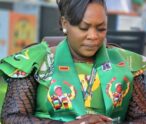
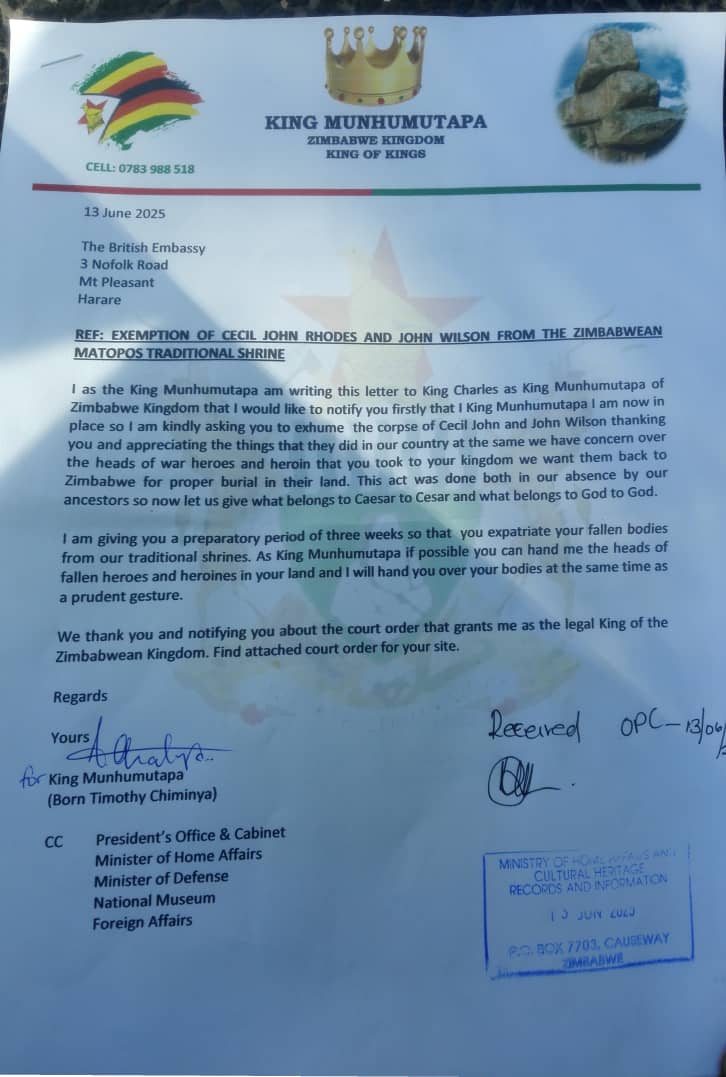
BULAWAYO, ZIMBABWE (News of The South)– In a significant move to reclaim ancestral lands and spiritual heritage, King Munhumutapa Timothy Chinuninya today served formal notice to the Ministry of Home Affairs, National Museums and Monuments, the Ministry of Local Government, and the British Embassy, demanding the exhumation and removal of Cecil John Rhodes’ remains and those of his associates from the sacred Matopos Hills.
King Munhumutapa stated that the British Embassy was already closed by the time the notice arrived, but reaffirmed that they would be served first thing tomorrow morning. He issued a stern ultimatum: the British must remove Rhodes and bury him in England, or his remains will be reinterred at Mbudzi Cemetery.
“Ndakuda kushandisa ruware rwangu pa Matopos. I am a man of action as King of Zimbabwe,” declared King Munhumutapa, emphasizing his resolve to see this long-standing issue resolved.
The call for the exhumation of Cecil John Rhodes, the controversial British imperialist and architect of colonial Rhodesia, has been a persistent demand for decades. For many years, appeals for his removal have been met with “discussions, silence, and no action,” according to the King. The continued presence of Rhodes’ grave at Malindidzimu, a site deeply sacred to indigenous Zimbabweans and known as “the place of spirits” or “burial place of the ancestors,” is widely perceived as a spiritual affront and a symbol of enduring colonial subjugation.
A History of Controversy and Spiritual Significance:
Cecil John Rhodes, who died in 1902, famously chose to be buried atop a granite hill in what he termed “World’s View” within the Matobo National Park (known locally as Matopos or Matobo Hills). This decision has been a source of continuous contention. The Matobo Hills are considered a national historical shrine and a central site for the traditional Mwari religion, serving as the resting place for important pre-colonial Zimbabwean kings and rulers, including King Mzilikazi.
Critics argue that Rhodes’ burial at such a revered site was a deliberate act of spiritual colonization, an attempt to assert dominance over the land and its people even in death. Groups like Sangano Munhumutapa and the “Rhodes Must Fall Zimbabwe” campaign have consistently highlighted the desecration of the sacred space and the pain it inflicts on the nation’s spirituality.
For generations, many Zimbabweans have maintained that the nation’s spirituality is greatly affected by Rhodes’ presence. It is widely believed that the removal of Rhodes and his men from Matopos is one of the instructions given by the revered spirit medium Mbuya Nehanda, a key figure in the First Chimurenga (war of liberation) against colonial rule. The belief is that the continued presence of a colonial oppressor in such a hallowed ground disturbs ancestral spirits and hinders the nation’s progress.
Past Calls and Future Implications:
Calls for Rhodes’ exhumation date back to the early 1980s, shortly after Zimbabwe gained independence. Various groups, including war veterans and cultural custodians, have pushed for his removal, citing the spiritual impurity and historical injustice. While former President Robert Mugabe had at times blocked such moves, the current President Emmerson Mnangagwa has also voiced support for the idea, even suggesting an exchange for ancestral remains held in the United Kingdom.
The debate surrounding Rhodes’ grave highlights the ongoing struggle to decolonize not just physical spaces but also historical narratives and spiritual landscapes. While some argue that the grave attracts tourism and should remain as a part of history, many Zimbabweans believe that true national healing and spiritual restoration can only occur once the remains of the colonizer are removed from their most sacred grounds.
King Munhumutapa’s decisive action today marks a renewed and determined effort to address this deeply rooted historical and spiritual grievance, promising to bring long-awaited closure to a contentious chapter in Zimbabwe’s post-colonial identity. The nation now awaits the response of the served ministries and, critically, the British Embassy, as the future of Cecil John Rhodes’ final resting place hangs in the balance.

Comments
About Author

Latest News

Yahoo Mail Down: Global Outage Leaves Thousands Facing ‘Temporarily Unavailable’ Errors
Please follow and like us: