

By HRH Princess Eugene Majuru, Princess of Harare
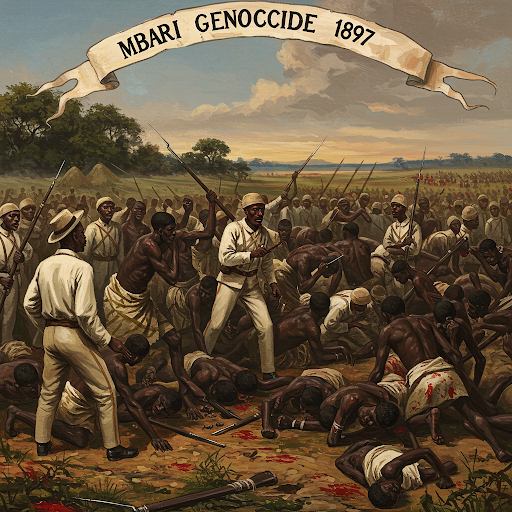
Harare, Zimbabwe (News of The South) – The King of Harare Kingdom, King Mbari of the Mbari clan, Harare`s Royal family lost his Kingdom in 1897 following the worst genocide in World history by British settlers when they colonised Zimbabwe. The British displaced Harare Royals who still live as destitute in other Chieftainships lands across Zimbabwe.
The aim was to wipe out the entire clan so they would never rise again, and would eventually be erased from history. Genocide is certain acts committed with the intent to destroy, in whole or in part, a national, ethnic, racial, or religious group. Genocide is an international crime, according to the Convention on the Prevention and Punishment of the Crime of Genocide (1948). The Mbari clan have a big case against the British for the brutal murders committed during colonialism, while this case has never been widely reported about, it doesn’t mean the case is buried and forgotten. Deliberate efforts by British not to document much of the history and encounters with the Mbari shows that they sought to completely erase their existence.
The BSAC after having finished fighting in Matebeleland area of Zimbabwe moved into Harare Kingdom which was a strong and vibrant Kingdom, because of the power of King Mbari and the area he ruled in the mission was to take over this great Kingdom and they would have managed to take over Zimbabwe. They had already fought against Zimbabweans in Masvingo and the Great Zimbabwe area but by conquering all those areas they would not have taken over Zimbabwe without the Harare Kingdom takeover. Most Zimbabweans still do not know, understand or appreciate the importance of Harare because they are not aware of the history or what makes the city/ Kingdom important, when colonialism took place the British knew the secrets.
The Mbari clan were exposed to large-scale, systematic crimes committed against them, a civilian population, this genocide that falls under the category of “mass atrocities.” The Mbari Kingdom territory covered Harare, Nyabira, Mount Hampden, Mazoe, Concession, Seke, King Mbari had his family speard all across these areas for strategic reasons, the main reason being should anything befall the Kingdom the whole clan would not be wiped out. All across this abovementioned territory the clan members were massacred but did not go down easily and not without a fight. The British used powerful machine guns and other superior weapons but the Mbari who had their own weapons superior to them used them to the best of their abilities and managed to fight back and kill their opponents much to the surprise of the settlers. As the battle thickened the Mbari hid in caves below the Kopje, others hid in more caves in Mazoe where they were safe but were sold out by collaborators like the Hwata who showed the British settlers where the clan members were hiding. The BSAP dynamited the caves and Mbari people died in the caves, their remains are still in the caves till today 2025.
One settler named Lt-Col Alderson’s Imperial Forces arrived to reinforce the British South Africa Police and combined patrols went into the Mazoe area to wear down the Mashona opposition. The BSAC summoned for back up and reinforcement to wipe out the Mbari clan. They beefed up their numbers and were much more brutal against a now depleted Mbari force. When King Makombe realised, they were greatly outnumbered he instructed his people to run away and disperse in different directions and go as far away as possible, settle wherever they could settle and multiply and prepare for a come back no matter how long it would take. They were instructed never to use any named or anything that would identify them with Harare or King Mbari or the Kingdom as they were now in danger of extinction. From this day The Harare Kingdom was destroyed and a very brutal constitution was later introduced in Zimbabwe, the constitution made sure Harare and Bulawayo would never have Chieftainships and this way the Mbari would never make a comeback.
Some of the Mbari clan who had managed to escape from the Harare Mbari Kingdom had settled in Chivhu at Makumimavi, they were followed by British settlers and massacred in their thousands, their remains are still scattered around and inside the Mountain at Makumimavi and the mountain is a no-go area as its very sacred due to non cleansing ceremony to appease the spirits of those who were killed in the genocide. Mbari clan have made several communication attempts with Buckingham Palace to enable them to carry out the necessary burials and cleansing and till today the issue remains unresolved. During the Genocide the settlers looted over 50 by 50kgs of gold and other minerals as well as artifacts and human remains from the Mbari clan and they are all still in London museums and other British and Scottish museums.
During the Mazoe siege one settler named Dan Judson penned the letter below, the letter shows how the British were struggling in the battle against the Mbari. The Letter below courtesy of National Archives Harare.
The letter written by Dan Judson said:
Very Urgent Alice Mine
Mazoe
H.H. The Administrator
Salisbury Friday June 19, 1896 10pm
Sir, – I beg to inform you that I arrived here about 1:30pm having literally fought our way through the whole of the Mazoe Valley. Lost two horses killed, and Tpr Niebuhr badly wounded and Pollett slightly (both these men’s horses were shot and they consequently rode behind riders on two other horses) In this respect I would mention Tpr Hendrikz who picked Pollett up and carried him nearly five miles. I sent back early in the day Tprs Finch, Guyon, King and Mulvaney with their horses (knocked up) Mr Salthouse, in charge here, reports Blakiston, Routledge, Dickenson, Cass and Faull killed. Since my arrival we have had natives firing on us at a distance varying from two hundred to fifteen hundred yards, and there is no doubt that we are all in a critical position as ammunition is rapidly running out. We have absolutely no shelter for the ladies and they have to crouch behind rocks; provisions also running out. It is imperative that a force of at least forty men, with a Maxim, should come out to our relief at once, as I am afraid that all the Mashona here will rise, if the present rebels (number estimated about one thousand – most Mashonas and easily licked) are not vigorously dealt with. Mesdames Salthouse, Cass and Dickenson are with us bearing up bravely.
When Relief Column enters Mazoe Valley let them watch closely the dense patches of grass along the roadside, as small parties of rebels lie in ambush. Send some Martini ammunition and we can then give them help. Men in laager, in addition to my patrol, are Darling, Spreckley, Zimmerman [later Rawson] Pascoe, Fairbairn, Stoddard and Salthouse. Mr Stamford Brown met us on the road and accompanied us here. I may mention that we sent most of the rebels – who shot horses and wounded our men – to the happy hunting grounds. Am sending this by dispatch rider (Cape boy Hendrik) who has been promised £100 if he delivers it safely. Send out twelve spare horses; we have two mules and a wagonette.
(Signed) Dan Judson
The Mbari clan used guerrilla tactics that included surprise attacks, ambush, siege as well as hit and run. Mazoe area became a no go area for the settlers who were always taken by surprise by the Mbari. Nyamadzawo ome of King Mbaris sons also cut off telegraph wires to isolate settler-families in the region. The spirit of Mbuya Nehanda operated from Makombe’s (Mbari’s) territory and also gave guidance and assistanceto fight. Combining spiritualism with guerilla warfare, the fighters were formidable. Colonial documents of this period refer to the area as the ‘troubled Mazowe area’. Some of the white settlers who died in the area were Frank Austin, a prospector, and James Steel, killed on June 24 1896. Walter Tapsell (June 21), Louis Herman (June 21) and William Harvey Brown (July 23). The siege of Deary’s Store in Mazoe took place from June 21 to July 31 1897. This gave the settlers a good run for their guns.
Instructions given to British South Africa Police (BSAP) were that the entire clan should be wiped out and all babies and children were to perish. To understand the extent of the Mbari Genocide various different acts are defined in the convention as acts of genocide, including: killing members of a group, causing serious bodily or mental harm to members of the group, deliberately inflicting on the group conditions of life calculated to bring about its physical destruction in whole or in part, imposing measures intended to prevent births within the group, forcibly transferring children of the group to another group. All the above happened in the Mbari Kingdom. The Mbari clan were a very powerful clan and used tactic to fight the British, the battle took longer than the British anticipated, by then King Mbari had died in 1892 due to old age and his young brother Makombe was the King. In incidents documented by the British King Makombe was named as Makombi, this same mistake continued till present day where we see Mbare suburb which was named after King Mbari is spelt as Mbare and Harare which was also named after King Mbari is spelt as Harare instead of Haarari. Haarari was King Mbari`s nickname due to him not sleeping because of helping people through the use of his special abilities. Harare should be spelt as Haarari.
In 1987, Gregory Stanton, a professor of law, published a paper which explored how genocides develop and unfold. Stanton identified eight key stages which resulted in acts of genocide. According to Stanton’s model, some of these stages can happen at the same time or in a different order. In 2012, Stanton expanded on these ideas, and added two further stages (Discrimination and Persecution) to make ten. According to Stanton’s current model, the stages of genocide are as follows:
Classification – Dividing people into ‘them’ and ‘us’.
1) Symbolisation – Forcing groups to wear or be associated with symbols which identify them as different.
2) Discrimination – Excluding groups from participating in civil society, such as by excluding them from voting or certain places. In Nazi Germany, for example, Jews were not allowed to sit on certain park benches.
3) Dehumanisation – To deny the humanity of one group, and associate them with animals or diseases in order to belittle them.
4) Organisation – Training police or army units and providing them with weapons and knowledge in order to persecute a group in future.
5) Polarisation – Using propaganda to polarise society, create distance and exclude a group further.
6) Preparation – Planning of mass murder and identifying specific victims.
7) Persecution – Incarcerating groups in ghettos or concentration camps, forcibly displacing groups, expropriating property, belongings or wealth.
8) Extermination – Committing mass murder.
9) Denial – Denial of any crimes. This does not necessarily mean denying that the acts of murder happened, but denying that these acts were a crime, and were in fact justified.
To understand more about the Mbari genocide see attached below, a document by the United Nations General Assembly on 9 December 1948, as result of the events of the Holocaust. The Convention came into force on 12 January 1951.
Convention on the prevention and punishment of the Crime of genocide:
Convention on the Prevention and Punishment of the Crime of Genocide
Approved and proposed for signature and ratification or accession by General Assembly resolution 260 A (III) of 9 December 1948
Entry into force: 12 January 1951, in accordance with article XIII
The Contracting Parties ,
Having considered the declaration made by the General Assembly of the United Nations in its resolution 96 (I) dated 11 December 1946 that genocide is a crime under international law, contrary to the spirit and aims of the United Nations and condemned by the civilized world,
Recognizing that at all periods of history genocide has inflicted great losses on humanity, and Being convinced that, in order to liberate mankind from such an odious scourge, international co-operation is required, Hereby agree as hereinafter provided :
Article I
The Contracting Parties confirm that genocide, whether committed in time of peace or in time of war, is a crime under international law which they undertake to prevent and to punish.
Article II
In the present Convention, genocide means any of the following acts committed with
intent to destroy, in whole or in part, a national, ethnical, racial or religious group, as
such:
(a) Killing members of the group;
(b) Causing serious bodily or mental harm to members of the group;
(c) Deliberately inflicting on the group conditions of life calculated to bring about its
physical destruction in whole or in part;
(d) Imposing measures intended to prevent births within the group;
(e) Forcibly transferring children of the group to another group.
Article III
The following acts shall be punishable:
(a) Genocide;
(b) Conspiracy to commit genocide;
(c) Direct and public incitement to commit genocide;
(d) Attempt to commit genocide;
(e) Complicity in genocide.
Article IV
Persons committing genocide or any of the other acts enumerated in article III shall be punished, whether they are constitutionally responsible rulers, public officials or private
individuals.
Article V
The Contracting Parties undertake to enact, in accordance with their respective Constitutions, the necessary legislation to give effect to the provisions of the present Convention, and, in particular, to provide effective penalties for persons guilty of genocide or any of the other acts enumerated in article III.
Article VI
Persons charged with genocide or any of the other acts enumerated in article III shall be tried by a competent tribunal of the State in the territory of which the act was committed, or by such international penal tribunal as may have jurisdiction with respect to those Contracting Parties which shall have accepted its jurisdiction.
Article VII
Genocide and the other acts enumerated in article III shall not be considered as political crimes for the purpose of extradition. The Contracting Parties pledge themselves in such cases to grant extradition in accordance with their laws and treaties in force.
Article VIII
Any Contracting Party may call upon the competent organs of the United Nations to take such action under the Charter of the United Nations as they consider appropriate for the prevention and suppression of acts of genocide or any of the other acts enumerated in article III.
Article IX
Disputes between the Contracting Parties relating to the interpretation, application or fulfilment of the present Convention, including those relating to the responsibility of a State for genocide or for any of the other acts enumerated in article III, shall be submitted to the International Court of Justice at the request of any of the parties to the dispute.
Article X
The present Convention, of which the Chinese, English, French, Russian and Spanish texts are equally authentic, shall bear the date of 9 December 1948.
Article XI
The present Convention shall be open until 31 December 1949 for signature on behalf of any Member of the United Nations and of any non-member State to which an invitation to sign has been addressed by the General Assembly.
The present Convention shall be ratified, and the instruments of ratification shall be deposited with the Secretary-General of the United Nations. After 1 January 1950, the present Convention may be acceded to on behalf of any Member of the United Nations and of any non-member State which has received an invitation as aforesaid. Instruments of accession shall be deposited with the Secretary-General of the United Nations.
Article XII
Any Contracting Party may at any time, by notification addressed to the Secretary-
General of the United Nations, extend the application of the present Convention to all or
any of the territories for the conduct of whose foreign relations that Contracting Party is
responsible.
Article XIII
On the day when the first twenty instruments of ratification or accession have been deposited, the Secretary-General shall draw up a procès-verbal and transmit a copy thereof to each Member of the United Nations and to each of the non-member States contemplated in article XI. The present Convention shall come into force on the ninetieth day following the date of
deposit of the twentieth instrument of ratification or accession. Any ratification or accession effected subsequent to the latter date shall become effective on the ninetieth day following the deposit of the instrument of ratification or accession.
Article XIV
The present Convention shall remain in effect for a period of ten years as from the date of its coming into force. It shall thereafter remain in force for successive periods of five years for such Contracting Parties as have not denounced it at least six months before the expiration of the current period. Denunciation shall be effected by a written notification addressed to the Secretary- General of the United Nations.
Article XV
If, as a result of denunciations, the number of Parties to the present Convention should become less than sixteen, the Convention shall cease to be in force as from the date on which the last of these denunciations shall become effective.
Article XVI
A request for the revision of the present Convention may be made at any time by any Contracting Party by means of a notification in writing addressed to the Secretary- General.
The General Assembly shall decide upon the steps, if any, to be taken in respect of such request.
Article XVII
The Secretary-General of the United Nations shall notify all Members of the United Nations and the non-member States contemplated in article XI of the following:
(a) Signatures, ratifications and accessions received in accordance with article XI;
(b) Notifications received in accordance with article XII;
(c) The date upon which the present Convention comes into force in accordance with
article XIII;
(d) Denunciations received in accordance with article XIV;
(e) The abrogation of the Convention in accordance with article XV;
(f) Notifications received in accordance with article XVI.
Article XVIII
The original of the present Convention shall be deposited in the archives of the United Nations. A certified copy of the Convention shall be transmitted to each Member of the United
Nations and to each of the non-member States contemplated in article XI.
Article XIX
The present Convention shall be registered by the Secretary-General of the United Nations on the date of its coming into force
Comments
About Author