

CO-AUTHORS: LAZARUS NYAGUMBO & BRIAN O DONGO DATE: MARCH 2026
Contents
Zimbabwe: A Cascade of Crises 2
1. Rising Transport Costs 2
2. Increasing Production Costs 2
3. Cost-Push Inflation Ramifications 2
4. Food Inflation 3
5. School & College Fees Inflation 3
6. Rent Inflation 3
7. Cement, Bricks, Pitsand, Riversand, Borehole Drilling Inflation 3
8. Falling Living Standards, Unemployment 3
9. ZiG Currency Depreciation 3
10. Despondency 4
11. Economy Slow Down, Recession, Depression 4
12. Other considerations: 4
Globally: Systemic Shocks and Shifting Landscapes 4
1. Cost-Push Inflation 4
2. Tourism Economy Slow Down 4
3. World Economy Slowdown, Recession 4
4. Protectionism 5
5. Other global impacts include: 5
Possible Solutions: Mitigating the Adverse Effects 5
1. Government Subsidies 5
2. Government Tax Cuts, Freezes, or Scrapping 5
3. Cut Down on Spending and Travel 6
4. Real Wage Adjustments (and the Risk of Spiral Inflation) 6
5. Real Economy & Structural Solutions 6
Conclusion: 7
Zimbabwe: A Cascade of Crises
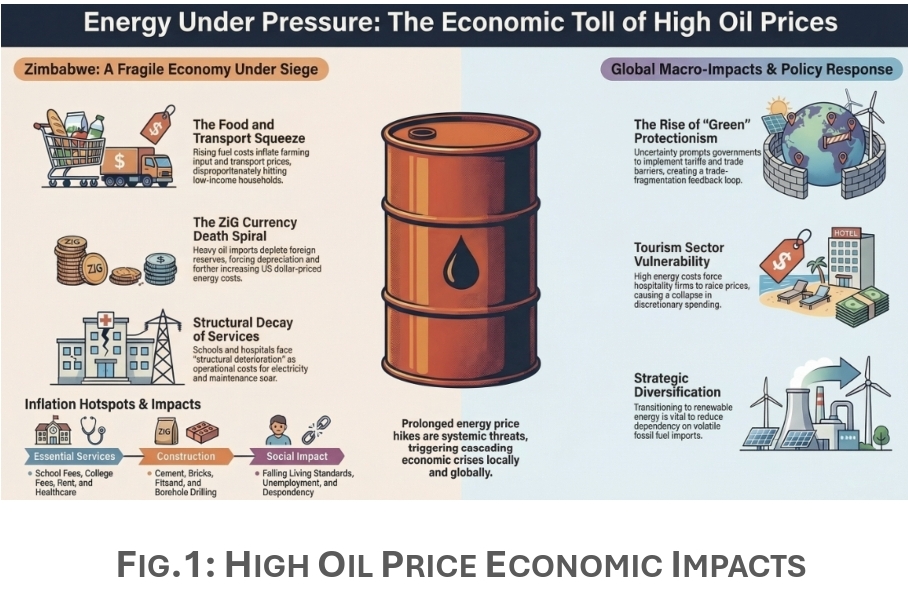
For a country like Zimbabwe, with its existing economic fragilities, prolonged high oil and gas prices act as a catalyst, triggering a multi-faceted and interconnected crisis.
FIG.1: HIGH OIL PRICE ECONOMIC IMPACTS
1. Rising Transport Costs
The immediate and most visible impact is on transportation. As a net importer of refined petroleum products, Zimbabwe’s transport sector is acutely sensitive to global oil price shocks. Increased diesel and petrol prices directly inflate the cost of moving people, goods, and raw materials. This affects everything from the price of a bus ticket for a worker to the cost of shipping agricultural produce from rural areas to urban markets. The pass-through effect is almost immediate.
2. Increasing Production Costs
Energy is a fundamental input for almost all productive sectors. Manufacturing, mining, agriculture, and construction face skyrocketing costs for running machinery, generating power (especially given Zimbabwe’s own power generation challenges), and operating equipment. This squeezes profit margins, forcing businesses to either absorb losses (leading to potential closure) or pass the costs onto consumers.
3. Cost-Push Inflation Ramifications
The combined effect of rising transport and production costs is a powerful wave of cost-push inflation. This is inflation driven not by increased demand, but by a reduction in aggregate supply due to higher input costs. The economy experiences a “stagflationary” shock, stagnant or shrinking economic output combined with persistently high inflation.
4. Food Inflation
This is a critical vulnerability. There is a bidirectional causality between domestic fuel costs and food inflation. Higher fuel prices increase the cost of:
Farming Inputs: Diesel for tractors, irrigation pumps, and the production and transport of fertilizers and pesticides.
Processing: Energy-intensive milling and packaging of staple foods like maize meal.
Distribution: Transporting food from farms to markets, and from import hubs to retail outlets.
The result is a direct reduction in food security, particularly for low-income households that spend a large share of their income on food. This often forces a shift to cheaper, less nutritious foods, worsening health outcomes.
5. School & College Fees Inflation
Educational institutions, particularly private and tertiary ones, are highly dependent on energy and transport. Higher fuel prices increase the cost of busing students, running school generators, heating/cooling buildings, and purchasing supplies. These operational cost increases are almost always passed on to parents in the form of higher fees, potentially pricing many families out of education and exacerbating social inequality.
6. Rent Inflation
Rent is not immune. Landlords face increased costs for utilities, security, and maintenance of their properties. Commercial tenants see these costs passed on through service charges. For residential properties, landlords may increase rent to keep up with the rising cost of living and their own expenses, creating a direct pressure on household budgets.
7. Cement, Bricks, Pitsand, Riversand, Borehole Drilling Inflation
The construction and real estate sector is energy-intensive. The production of cement and bricks requires immense heat, often from fossil fuels. Transporting heavy construction materials like sand and stone is a fuel-intensive activity. Drilling boreholes relies on diesel-powered machinery. Soaring energy prices cause the costs of these essential materials and services to skyrocket, stalling construction projects, increasing the cost of housing, and making essential water access infrastructure unaffordable.
8. Falling Living Standards, Unemployment
As inflation erodes purchasing power and businesses struggle with high costs, the result is a sharp decline in living standards. Real wages (wage adjusted for inflation) plummet. To survive, firms reduce investment, cut down on operations, and lay off workers, leading to a surge in unemployment. This creates a vicious cycle: less income leads to less demand, which leads to more business closures and job losses.
9. ZiG Currency Depreciation
For Zimbabwe, this is a critical flashpoint. As an oil importer, the country needs a steady supply of US dollars to pay for fuel. A prolonged oil price surge drastically increases this demand for foreign currency. If the country’s foreign exchange earnings (from exports, diaspora remittances) cannot keep pace, the local currency, the ZiG, comes under immense speculative pressure. This leads to rapid devaluation. A weaker ZiG makes imports even more expensive, fuelling further inflation, creating a classic “vicious cycle” of depreciation and inflation.
10. Despondency
The economic hardship translates into social and psychological distress. High unemployment, constant price increases, and a feeling of economic hopelessness can lead to widespread despondency, increased crime rates, social unrest, and a “brain drain” as skilled professionals seek better opportunities abroad.
11. Economy Slow Down, Recession, Depression
The cumulative effect of all these factors is a severe macroeconomic contraction. Investment collapses, consumer spending plummets, and the industrial base erodes. This pushes the economy into a slowdown, then a technical recession (two consecutive quarters of negative GDP growth), and, if prolonged and severe, into a depression characterized by a sustained, deep downturn in economic activity and mass unemployment.
12. Other considerations: This list could be extended to include: increased informal sector activity (often exploitative), a widening budget deficit (as government spends more on fuel subsidies or imports while tax revenue falls), and a deterioration of public services due to budget cuts.
Globally: Systemic Shocks and Shifting Landscapes
The impact of prolonged high oil and gas prices extends far beyond any single nation, creating systemic risks for the entire global economy.
1. Cost-Push Inflation
Globally, the primary mechanism is the same: cost-push inflation. The shock is transmitted through global supply chains. For developed economies like the EU, rising energy prices are a primary driver of headline inflation, affecting everything from manufacturing to household heating. For developing nations, the effect is often more severe due to a lack of monetary policy flexibility, a larger share of food and energy in the consumer basket, and greater dependence on imports.
2. Tourism Economy Slow Down
The tourism sector, a vital source of revenue for many countries e.g., Caribbean, Mediterranean, is highly vulnerable. Rising fuel costs directly increase the price of air travel and land transport, making holidays more expensive and reducing demand. Energy-intensive tourism businesses, hotels, resorts, cruise lines, see their operational costs surge, forcing them to raise prices, reduce services, or even close, leading to significant job losses and economic contraction in tourism-dependent regions.
3. World Economy Slowdown, Recession
Sustained high energy costs act as a major tax on global economic activity. They reduce corporate profitability, dampen investment, and erode consumer purchasing power, leading to a synchronized slowdown across major economies. Historical evidence from the 1970s oil crises shows that such shocks are strongly associated with global recessions and stagflation, a combination of high inflation and high unemployment that is particularly difficult for policymakers to manage.
4. Protectionism
A critical geopolitical consequence is the rise of protectionism. When faced with high inflation and a domestic economic downturn, governments face intense political pressure to protect their own industries and jobs. This leads to the imposition of tariffs, quotas, and other trade barriers. These protectionist measures, whether retaliatory, e.g., US-China trade war or defensive, disrupt global supply chains, reduce international trade volumes, and fragment the global economy. This creates a dangerous feedback loop: ENERGY SHOCKS CAUSE INFLATION → INFLATION TRIGGERS PROTECTIONISM → TRADE SLOWS → ECONOMIC GROWTH WEAKENS FURTHER, deepening the initial recession.
5. Other global impacts include:
Financial Instability: Currency volatility in emerging markets, capital flight to safe-haven currencies (like the USD), and increased stress on sovereign debt.
Geopolitical Fragmentation: Energy shocks exacerbate existing geopolitical rivalries, leading to the formation of competing economic blocs and a move away from multilateralism.
Acceleration of Green Energy Transition: High fossil fuel prices can paradoxically accelerate the long-term shift towards renewable energy and energy efficiency as governments and businesses seek to reduce their vulnerability and meet climate goals.
Possible Solutions: Mitigating the Adverse Effects
To navigate this crisis, coordinated and strategic responses are needed from consumers, households, businesses, and governments.
1. Government Subsidies
Targeted subsidies can cushion the blow for the most vulnerable, but they must be carefully managed.
Targeted Cash Transfers: Instead of universal fuel subsidies, which are expensive and often benefit the wealthy more than the poor, governments can implement cash transfer programs. These provide direct income support to low-income households to help them cope with higher food and transport costs without distorting market prices.
Food and Public Transport Subsidies: Direct subsidies for staple foods or public transport fares can act as a safety net, preventing immediate destitution and social unrest.
2. Government Tax Cuts, Freezes, or Scrapping
Reducing the tax burden on fuel and essential goods can offer immediate, albeit temporary, relief.
Fuel Levy Cuts: Temporarily reducing or scrapping excise duties on fuel can prevent the full shock of global price increases from being passed on to consumers.
Suspension of VAT on Essentials: Removing or reducing Value Added Tax (VAT) on basic food items, electricity, and water can help curb the rate of cost-push inflation.
3. Cut Down on Spending and Travel
This is a necessary, albeit painful, adjustment at all levels.
Households: Reducing discretionary spending, carpooling, using public transport, and improving home energy efficiency e.g., insulation, efficient appliances.
Businesses: Optimizing logistics, reducing energy waste, investing in energy-efficient machinery, and implementing remote work policies to reduce travel and office energy consumption.
Government: Reducing non-essential official travel, consolidating government vehicle fleets, and implementing energy-saving measures in public buildings.
4. Real Wage Adjustments (and the Risk of Spiral Inflation)
This is the most delicate and dangerous area. If inflation erodes real wages, workers will demand higher nominal wages to maintain their living standards. If businesses grant these raises, they will pass the higher labour costs on to consumers, creating a self-perpetuating wage-price spiral.
The Risk: A spiral can cause inflation to become entrenched and very difficult to break without a severe recession.
Mitigation: To avoid this, a social compact is needed. Governments, unions, and businesses must engage in incomes policy discussions to reach a consensus on moderate, productivity-based wage increases that do not fuel further inflation. This often requires government to play a mediating role and commit to other anti-inflationary measures e.g., price controls on essential goods, credible monetary policy.
5. Real Economy & Structural Solutions
The most sustainable solutions are long-term and structural.
Energy Diversification: Aggressively invest in renewable energy sources (solar, wind, hydro) to reduce dependence on imported fossil fuels. This is a key strategy for both Zimbabwe and the global community.
Local Refining & Production: For countries like Zimbabwe, supporting local initiatives for fuel refining or biofuels can reduce exposure to volatile international markets.
Supply Chain Resilience: Investing in infrastructure (roads, rail) to reduce domestic logistics costs and diversifying import sources to avoid over-reliance on any single region.
Strengthen Monetary Policy: For central banks, maintaining credibility is key. While monetary policy has limits in fighting cost-push inflation, a credible commitment to controlling inflation through interest rate policy and exchange rate stability can help anchor expectations and prevent the wage-price spiral from taking hold.
Conclusion:
The economic impact of prolonged high oil and gas prices is a systemic threat that cascades from the global macroeconomy down to the individual household. For import-dependent nations like Zimbabwe, the effects are amplified by currency vulnerabilities and existing structural weaknesses. Mitigation requires a multi-layered approach: immediate relief through targeted subsidies and tax measures; behavioural changes from consumers and businesses; a delicate balancing act in wage negotiations to avoid spirals; and, most critically, a long-term strategic pivot towards energy diversification, economic resilience, and strengthened governance to weather future shocks.
Comments
About Author