


By Michael Chingarande
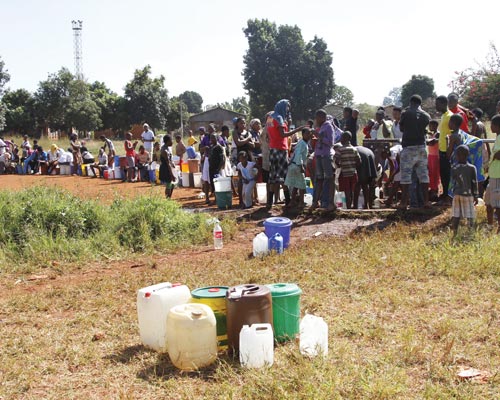
Zimbabwean residents in the high density suburb of Mabvuku in Harare continue to endure decades of no water supply and frequent long-queues at boreholes and wells .
The shortage of water in the area has also changed the face of the place for most households are now owners of wells as the only source of water.
However the digging of wells has not changed much in curbing the crisis of water in the area, since most of the wells are not that deep and the water table is very low during summer.
The water sometimes comes out dirty and not suitable for drinking and washing clothes and dishes.
A Mabvuku resident Sharon aged 23 narrated the challenges she has been facing for the past 7 years.
“I walk more than 2 kilometers to the borehole where 20 other women have queued up. It takes an hour or so to finally get water and sometimes you can even go home without the precious liquid .
‘Unfortunately, the 25 litres is not enough because my husband uses at least half of it not mentioning my three school going children, they need to eat and bath before going to school,” she said.
She added that chaos at borehole points has become common with women being the most affected.
“Sometimes there is chaos and exchange of blows because of water even during the night and this has left “us” women vulnerable to all forms of abuse at the borehole points .
“Something has to be done to stop this and protect our families and little children from all forms of abuse at boreholes”she said.
The Harare Residents Trust member Mrs Makurumure said.
“The problem of water is something that we have tried to deal with through the city council but nothing has been done so far so and this has left our residents hopeless for the future of water supply in the area.
“It is unfortunate that very little is known about this deal between the City of Harare and the Chinese Eximbank, but what is known is that residents will repay this loan at an interest rate above 10 percent”she said.
Results of a recent survey by the Environmental Management Agency (EMA) at four boreholes in a residential area close to a chemical plant in Harare’s Msasa industrial area indicated that the water’s mineral content or hardness far exceeded the permissible limit.
Laden with sulphates and manganese, the water hardness of each of the boreholes were 776, 1 541, 743, 696 against a permissible limit of between 20 and 300.
While water hardness per se has no known health side effects to humans, according to the World Health Organisations guidelines, EMA believes that where industry, a major generator and consumer of hazardous waste and substances, is involved it is highly likely that the hard water in areas close to industrial areas contains poisonous or toxic substances harmful to the environment and human health.
In residential areas sewerage spillages and septic tanks also pollute the underground water reservoir.
The current water problems mirror the general state of decline being witnessed in other sectors including education, health and transport infrastructure.
Late last month, President Robert Mugabe caused outrage when he threatened to deprive residents of Harare and Bulawayo of essential services for ditching him in the July elections.
Comments
About Author





Comments Closed .