

By Kyran Titterton
Introduction: A New “All-Weather” Era
The geopolitical architecture of Africa is undergoing a profound transformation. As Western influence on the continent experiences a relative decline, a multipolar reality is taking root, driven largely by the strategic, economic, and security engagements of the People’s
Republic of China and the Russian Federation. For African nations, this shift presents a new era of bargaining power.
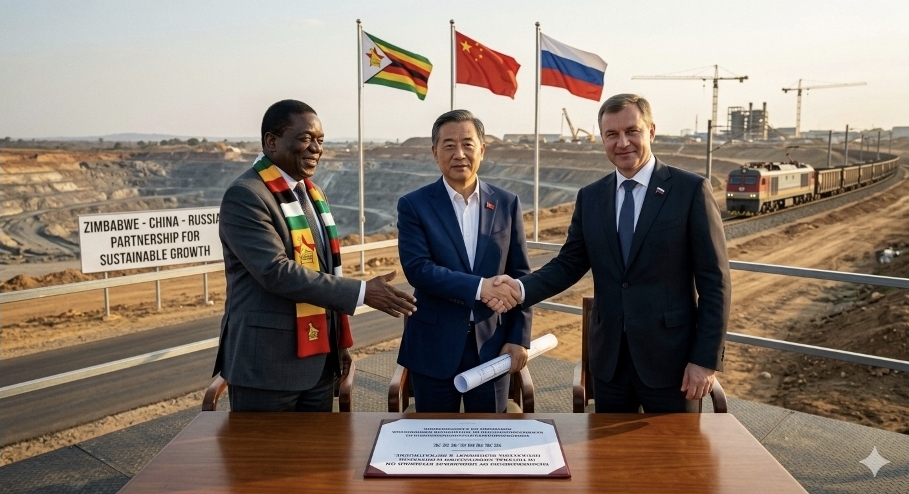
Nowhere is this dynamic more pronounced than in Zimbabwe. Isolated by Western sanctions for over two decades, Zimbabwe pioneered a “Look East” policy that has evolved into a highly integrated economic and strategic partnership. In September 2025, during President Emmerson Mnangagwa’s visit to Beijing, Zimbabwe and China officially elevated their diplomatic ties to an “all-weather community with a shared future.” By examining the Sino-Russian engagement through the specific lens of Zimbabwe, we can better understand the distinct strategies of Beijing and Moscow in the mid-2020s.
China’s Strategic Blueprint:
The Lithium Paradigm Shift
China’s approach to Africa is fundamentally anchored in economic integration and securing supply chains for its green energy transition. In Zimbabwe, this relationship is largely defined by one critical mineral: lithium. Chinese battery giants like Huayou Cobalt, Sinomine, and Chengxin Lithium have poured nearly US$1.4 billion into Zimbabwean assets since 2021.
However, the dynamic between Harare and Beijing shifted dramatically in early 2026 when Zimbabwe tightened its ban on the export of raw lithium concentrates to force local value addition.
• The Supply Shock: Prior to the ban, Zimbabwe supplied roughly 15% to 19% of China’s imported spodumene. The sudden enforcement of these export restrictions caused a short-term supply shock for Chinese battery manufacturers.
• Domestic Processing: Rather than retaliating,
Chinese firms adapted. In early 2026, a massive US$400 million lithium sulphate plant—developed by a subsidiary of China’s Zhejiang Huayou Cobalt—is slated to begin operations, moving Zimbabwe up the value chain.
• Diplomatic Pragmatism: In a rare move highlighting the tension of this transition, the Chinese Embassy in Zimbabwe issued a strict advisory in mid-March 2026. The embassy warned Chinese enterprises to strictly abide by Zimbabwe’s evolving environmental and mining laws, demonstrating China’s pragmatic approach to securing its investments without interfering in host-nation policy. Furthermore, China’s new zero-tariff policy for 53 African nations, beginning in May 2026, aims to offset these frictions by boosting broader industrial imports.
Russia’s Resurgence:
Nuclear Energy and SMR
Diplomacy
While China leads with massive capital and infrastructure, Russia leads with security, ideological solidarity, and niche technological exports. Following a period of waning influence after the Cold War, Moscow has aggressively re-engaged with Africa, framing its partnerships as a united front against Western hegemony.
In Zimbabwe, Russia’s economic footprint is smaller, but highly strategic—particularly in the energy sector:
• Small Modular Reactors (SMRs): Following an intergovernmental agreement on the peaceful use of atomic energy signed with Rosatom in 2023, Russia has positioned itself as the solution to Zimbabwe’s chronic energy deficits. Rosatom is heavily promoting its advanced SMR technology, such as the RITM-200 pressurized-water reactor.
• Energy Diversification: These SMRs offer a highly attractive alternative to the polluting diesel generators and unreliable hydro-power currently utilized by Zimbabwe’s mining sector. While Zimbabwe is also exploring SMR technologies with South Korean entities (like KHNP) to achieve its Vision 2030 goals, Russia remains the primary geopolitical partner driving the nation’s nuclear ambitions, backed by the technical support of the International Atomic Energy Agency (IAEA).
The BRICS Ambition:
De-Dollarization and Global
Integration
A major convergence point for Russian and Chinese strategies in Zimbabwe is the expansion of the BRICS economic bloc. Both Beijing and Moscow actively encourage African nations to join structures that dilute the dominance of Western financial institutions.
In early 2026, Zimbabwe’s Foreign Affairs Minister,
Amon Murwira, intensified Harare’s diplomatic campaign to secure fast-tracked BRICS membership and integration into the New Development Bank (NDB). For Zimbabwe, the motivation is clear:
• Sanctions Evasion: Decades of currency instability and economic isolation have made the US dollar a volatile necessity.
• Alternative Trading: By integrating into BRICS, Zimbabwe aims to trade in local currencies, secure development financing outside the IMF/World Bank structures, and insulate its economy against recent hardline shifts in US trade policies.
Conclusion
The Sino-Russian engagement in Zimbabwe represents a microcosm of the broader geopolitical shift across the African continent. The contrasting but complementary forces of Chinese economic hegemony (particularly in the lithium sector) and Russian strategic nuclear diplomacy have created a complex triad.
As global competition for critical minerals intensifies and the push toward a multipolar world accelerates, Zimbabwe finds itself in a position of unprecedented leverage. Ultimately, the success of this multifaceted relationship will depend on Zimbabwe’s ability to enforce robust governance, negotiate equitable terms, and harness these eastern partnerships to power its own sovereign industrialization.
Comments
About Author