

Colonial occupation displaced royal families, governments altered traditional boundaries and new chiefs acquired administrative recognition. But the Mbari royal house maintains that ancestral custodianship cannot be transferred through political appointments. From Harare and Mazowe to Mount Hampden and Nyabira, the clan points to historical ceremonies, sacred places and continuing spiritual responsibilities as evidence of a connection to the land that has survived generations of displacement.
By Princess Eugene Majuru | News of The South
Governments can redraw boundaries. Colonial administrators can abolish chieftainships. Politicians can recognise one traditional leader while refusing to acknowledge another. Communities can be displaced from their ancestral territories, and royal families can remain scattered across the country for generations. But according to the Mbari royal house of Harare, there is one authority that cannot be abolished through legislation, political appointments or administrative decisions: the spiritual relationship between ancestral land and the bloodline entrusted with its custodianship. The royal house maintains that although colonial occupation disrupted its hereditary leadership over Harare and surrounding territories, it never extinguished the clan’s ancestral responsibilities. Its position is rooted in a principle of African traditional belief: land carries the memory of its ancestors, and sacred places remain connected to the lineages historically responsible for them. Within this understanding, the spiritual custodianship of ancestral territory cannot simply be transferred to another family because a colonial administrator recognised a different chief.
The Mbari royal house argues that this distinction is central to the unresolved question of the Harare chieftainship. It maintains that when traditional spiritual matters arise in Harare, Mazowe, Mount Hampden and Nyabira, the appropriate custodians must be identified through ancestral lineage rather than political recognition alone. The family further claims that government representatives and other individuals have, on various occasions, sought assistance from Mbari clan members in addressing matters regarded as spiritually significant. Those claims require examination of the individual ceremonies, who requested them and what roles the participants performed. However, the clan’s published historical accounts identify several ceremonies, with dates, which it presents as evidence of its continuing customary responsibilities. The resulting question is significant: if a royal family’s ancestral role continues to be acknowledged in traditional ceremonies, why does its claim to formal traditional leadership remain unresolved?
Political authority can be transferred, but can ancestral authority?
British colonial occupation fundamentally transformed traditional leadership in Zimbabwe. Kings and chiefs lost their political independence. Traditional jurisdictions were reorganised, communities were displaced and colonial officials acquired extensive influence over hereditary appointments. The Native Commissioner system placed African traditional leaders under administrative supervision. In some cases, chiefs were removed or demoted, while others were granted recognition over reorganised territories. These arrangements could determine who exercised political authority over a community. But in African traditional belief, the authority to administer a territory and the ancestral responsibility to perform its sacred ceremonies are not necessarily identical.
A government may appoint or recognise a chief according to law. It cannot, by that act alone, establish that the appointed person’s ancestors historically occupied every sacred place within the jurisdiction. Nor does legal recognition automatically resolve disputes over which lineage traditionally performs ceremonies associated with particular graves, mountains, rivers or shrines. This distinction lies at the centre of the Mbari royal house’s argument. The clan maintains that the political displacement of its hereditary leadership did not transfer its ancestral responsibilities to families subsequently recognised within the same geographical territory.
The Mbari claim: Harare, Mazowe, Mount Hampden and Nyabira
The Mbari royal house traces its traditional authority to King Mbari of the Shumba Gurundoro lineage. According to the family’s historical accounts, its ancestral territory extended across present-day Harare and into surrounding areas, including Mazowe, Mount Hampden and Nyabira. The clan identifies particular hills, burial places and ceremonial sites as important elements of its ancestral heritage. Its published genealogy also associates the Nyabira area with Nyavira, identified in the family tradition as a son of Mbari, and describes a sacred hill in the area. These accounts form part of the family’s evidence for its historical connection to the territory. Other traditional houses have competing historical claims over parts of the wider Harare region, and the precise extent of precolonial jurisdictions remains contested. The Mbari royal house nevertheless maintains that its customary spiritual responsibilities have continued despite the disappearance of its chieftainship from official recognition. For the family, the issue is not simply where an ancestor once lived. It is whether the lineage continues to be recognised through traditional practices associated with the land.
1993: The ceremonies at Dzivarasekwa Presidential Guard
One of the earliest dated examples identified in the Mbari clan’s published historical account concerns ceremonies reportedly conducted at Dzivarasekwa Presidential Guard in 1993. The account states that Mbari clan members performed traditional appeasement rituals at the site. The family presents the ceremony as an example of its continued involvement in ancestral matters after independence. The reported event is particularly significant to its argument because it concerns a location associated with a national security institution. However, the available published account does not independently establish which government official, if any, formally requested the ceremony, who authorised it or what official records were created. Those details matter when assessing the family’s broader claim that state institutions have sought its spiritual assistance. Nevertheless, the 1993 ceremony forms part of the clan’s publicly documented historical narrative. It raises a question about whether the traditional responsibilities exercised by royal families have been adequately recorded within Zimbabwe’s official heritage and traditional leadership institutions.
1997: The reported appeasement of 596 First Chimurenga graves in Mazowe
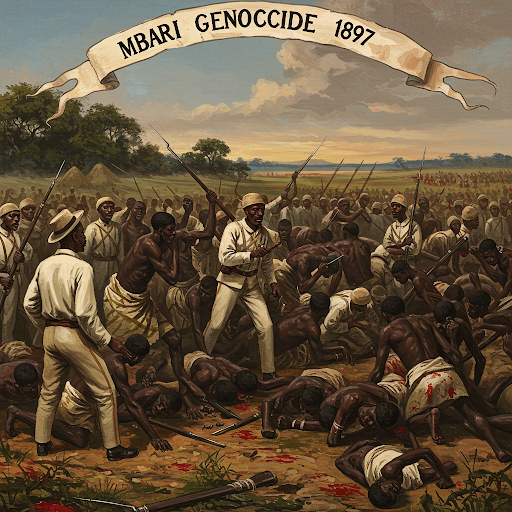
An even more substantial claim concerns ceremonies reportedly performed in Mazowe in 1997. The Mbari clan’s published historical account states that its members conducted rituals associated with 596 graves linked to victims of the First Chimurenga. The First Chimurenga of 1896–1897 was a defining period of African resistance to British colonial occupation.
The Mazowe area witnessed serious conflict during the uprising, and the broader history of the region remains closely connected to resistance against colonial rule.
According to the Mbari royal house, the 1997 ceremonies were intended to address ancestral obligations associated with those who died during the struggle.
The figure of 596 graves is reported in the family’s account and would require verification through burial records, archaeological documentation or contemporary records of the ceremony.
Nevertheless, the claim illustrates the importance the royal house places on the relationship between ancestral territory, historical resistance and traditional ceremonial responsibility.
The family argues that those who died defending the land should not be forgotten simply because colonial occupation subsequently changed its political administration.
For the Mbari royal house, ancestral recognition is inseparable from the history of those who resisted colonial conquest.
2007: Traditional ceremonies at Harare Kopje
Another ceremony identified in the clan’s historical record reportedly took place at Harare Kopje, also associated with Chihoka Hill, in 2007.
Harare Kopje occupies a prominent position in the landscape of Zimbabwe’s capital.
The Mbari royal house regards the site as part of its ancestral heritage and identifies it with the traditional history of the territory before colonial occupation.
According to the family’s account, Mbari clan members conducted rituals there in 2007.
The ceremony is cited as further evidence that the clan continued to perform traditional responsibilities in Harare long after the city had developed into a modern administrative and commercial centre.
The significance of the reported ceremony extends beyond the event itself.
It challenges the assumption that urbanisation necessarily removes the cultural importance of ancestral places.
A hill does not cease to have historical significance because roads, offices and buildings have been constructed around it.
Similarly, a traditional community’s connection to a place may survive even when the surrounding area is governed through modern municipal institutions.
The Mbari royal house argues that the continued performance of ancestral ceremonies should be considered when examining its restoration claim.
Mount Hampden: The 2024 dispute over ancestral graves
A more recent public controversy arose in March 2024 over concerns about ancestral graves in the Mount Hampden area, where major development projects were taking place.
The issue became public after concerns were raised about the treatment of burial sites and whether appropriate traditional consultations had occurred.
On 13 March 2024, the Ministry of Home Affairs and Cultural Heritage issued a statement responding to allegations that graves were being destroyed to accommodate development.
The ministry rejected the suggestion that traditional consultation had been ignored.
It stated that consultations had taken place and that further engagement was continuing.
The ministry identified Chief Zvimba as the recognised traditional authority consulted in connection with the project.
Importantly, the government also acknowledged the historical existence of claims by several clans associated with Greater Harare, including Mbari, Gutsa and Hwata.
It maintained that questions concerning the legal and traditional status of those claims fell within the responsibilities of other government departments.
This official response is significant.
It demonstrates that the government was aware of competing historical claims concerning the wider Harare region.
However, the ministry’s statement did not recognise the Mbari royal house as the legally established custodian of Mount Hampden.
Nor did it confirm that the clan had been summoned to resolve the grave-related concerns.
For the Mbari royal house, the controversy illustrates the need for a clearer process to establish which ancestral lineages should be consulted when development affects sacred or burial sites.
What happens when traditional ceremonies are performed by the wrong lineage?
The Mbari royal house maintains that traditional ceremonies connected to ancestral land must be conducted according to the customs of the lineage responsible for that territory.
Within this belief system, ancestral authority cannot be acquired merely by assuming a title or receiving political recognition.
The family argues that when ceremonies are undertaken without the participation of the appropriate custodians, the customary requirements of the land may remain unresolved.
It also alleges that some individuals or groups who claim authority over the wider Harare territory have been unwilling or unable to undertake certain traditional responsibilities when approached.
These are claims that would require specific examples and testimony before conclusions could be drawn about the conduct of other clans.
Spiritual effectiveness itself cannot be independently established through historical records or scientific methods.
But the underlying customary question is legitimate: who, according to the traditions of the affected community, has authority to conduct a particular ceremony?
In Zimbabwean traditional practice, the answer may depend on ancestry, recognised spirit mediums, hereditary custodianship and the specific sacred place concerned.
A chief recognised for administrative purposes may not necessarily perform every spiritual function within the chief’s jurisdiction.
Conversely, a lineage responsible for a particular shrine may exercise ceremonial responsibilities without possessing a formally recognised chieftainship.
The two forms of authority can overlap, but they should not automatically be treated as identical.
Why the Mbari royal house rejects spiritual impersonation
The family strongly rejects what it describes as attempts by outsiders to assume ancestral responsibilities associated with Mbari territory. Its position is that a person cannot establish hereditary custodianship simply by claiming that a particular area belongs to their clan. According to the royal house, ancestral responsibility must be established through genealogy, customary recognition and the history of the sacred sites concerned. The family argues that political recognition cannot substitute for that lineage-based authority. This is why it regards traditional ceremonies as an important dimension of its restoration campaign. It maintains that the continued involvement of Mbari descendants in ceremonies associated with Harare and Mazowe demonstrates that their ancestral connection has survived colonial displacement. However, the existence of a ceremony does not, by itself, establish exclusive legal ownership of a territory. The historical significance of the ceremony must be assessed alongside evidence concerning customary jurisdiction, succession and competing traditional claims. That distinction does not diminish the cultural importance of the family’s account. It helps separate spiritual custodianship, historical land rights and contemporary legal authority.
When government seeks ancestral assistance, should it also recognise the royal house?
One of the most serious allegations advanced by the Mbari royal house concerns what it describes as inconsistent treatment by public authorities. The family maintains that individuals acting in connection with government institutions have, on various occasions, approached selected clan members for assistance with traditional spiritual matters. Yet the family says its wider restoration claim remains unresolved. It further alleges that some approaches have been made privately, without consultation with the broader royal house or its recognised custodians. If substantiated, such arrangements would raise questions about how public authorities identify the appropriate representatives of a traditional lineage. Who authorised the consultations? Were the ceremonies formally requested? Which clan members participated? Was the wider royal house informed? And were the ceremonies documented by the institutions involved? These questions are particularly important where public bodies are alleged to have relied upon traditional custodians while declining to address their formal representations concerning hereditary recognition. The Mbari royal house maintains that cultural responsibilities should not be acknowledged only when assistance is needed. It argues that traditional institutions deserve consistent recognition, transparent consultation and respect for their internal customary procedures.
The land remembers: Ancestral identity beyond colonial boundaries
For many African communities, land carries historical meaning that cannot be reduced to ownership documents or administrative maps. Sacred hills, burial grounds, rivers and ancestral shrines may preserve relationships between generations. Traditional ceremonies can provide continuity between living communities and their ancestors. These beliefs survived colonial occupation and remain important to many Zimbabweans today. The Mbari royal house expresses that relationship through the conviction that ancestral territory continues to recognise the lineage historically responsible for its protection. In the family’s understanding, displacement cannot erase ancestry. The abolition of a chieftainship cannot destroy the memory of its founding lineage. And political recognition of another authority does not necessarily transfer the sacred responsibilities associated with particular ancestral places. The family therefore regards the restoration of its chieftainship as both a historical and cultural question. It is not simply seeking the return of a title. It is seeking acknowledgement of a hereditary institution that it maintains survived through generations of displacement.
Why spiritual custodianship and political administration must be distinguished
Modern government operates through constitutional law, elected institutions and administrative procedures. Traditional spiritual responsibilities operate through different systems of belief, customary authority and cultural practice. The two may interact, particularly where government development projects affect burial grounds or sacred sites. But political authority does not automatically establish spiritual legitimacy. A minister can approve a development project. A municipal authority can regulate land use. A government department can determine the legal process for protecting or relocating graves. Yet these decisions do not, by themselves, determine which ancestral lineage a community recognises as the appropriate ceremonial custodian. That question requires engagement with the relevant customary institutions. At the same time, traditional claims cannot override the legal rights of residents, landholders or other communities without due process. Zimbabwe’s challenge is to respect ancestral heritage while ensuring that questions of legal authority are resolved transparently and fairly.
Why the Mbari restoration claim remains important
In September 2025, the Mbari royal house’s campaign for restoration received public attention when its correspondence to government and the National Council of Chiefs was reported.
The family called for urgent consultations concerning the resuscitation of the Harare chieftainship. It argued that colonial occupation had displaced its hereditary institution without extinguishing its ancestral responsibilities. The royal house has continued to question why its historical claims have not received a substantive determination. Its concerns include hereditary succession, ancestral territory, the preservation of sacred sites and the authority to perform traditional ceremonies. The reported ceremonies of 1993, 1997 and 2007 form part of the evidence the family believes should be examined. The Mount Hampden dispute of March 2024 adds a more recent example of the difficulties that arise when development, historical claims and traditional consultation intersect. Taken together, these matters strengthen the case for a formal historical inquiry. Such an inquiry would need to examine the family’s records, identify participants in the reported ceremonies, consider competing claims and establish the customary and legal significance of the evidence.
Colonialism could remove a chief, but could it erase ancestral custodianship?
The history of Zimbabwe’s traditional leadership cannot be understood solely through colonial appointments, government registers and administrative boundaries. For many communities, ancestral authority also survives through genealogy, sacred places, burial grounds and customary ceremonies. The Mbari royal house maintains that this is precisely what happened in Harare.
It argues that colonial occupation displaced its hereditary leadership but did not destroy the ancestral responsibilities of the Shumba Gurundoro lineage. The family points to reported ceremonies at Dzivarasekwa Presidential Guard in 1993, Mazowe in 1997 and Harare Kopje in 2007 as examples of continuing traditional involvement. It also cites the wider debate over ancestral graves at Mount Hampden as evidence of the need to examine historical custodianship more carefully. These events and claims deserve investigation on their individual merits. The government has acknowledged that competing historical claims exist in the Greater Harare region. The responsibility now is to ensure that those claims can be examined through a process that respects historical evidence, customary practices and constitutional law. For the Mbari royal house, the principle remains unchanged: A royal family may be displaced from its ancestral territory. Its chieftainship may disappear from official recognition. Its descendants may be scattered across the country. But within the clan’s ancestral tradition, the land does not forget the bloodline entrusted with its custodianship. Political authority can change. Administrative boundaries can be redrawn. Cities can expand over ancient settlements and sacred places. But the historical and cultural relationships between communities and their ancestral territories deserve to be preserved and properly understood. The unresolved question for Zimbabwe is whether the restoration of traditional leadership will consider not only who was recognised by colonial administrators, but also the ancestral lineages whose customary responsibilities continued after their political authority was taken away. For the Mbari royal house, that question goes to the heart of its campaign for the restoration of the Harare chieftainship.
Comments
About Author