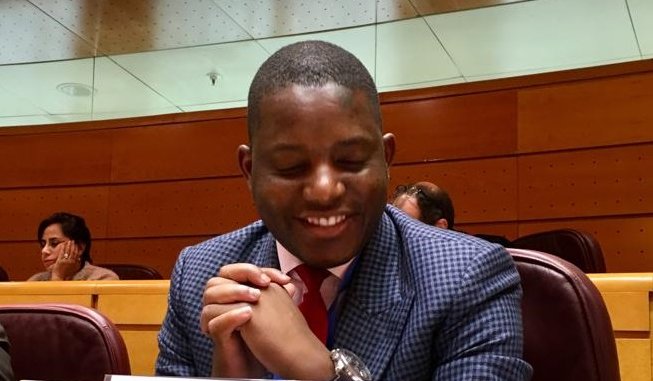


Stephen T Chifamba
“Being Deputy (minister) hasn’t met the expectations of most!
“You get a Prado, driver, aide, newspapers & tea in the morning. That’s it! You neither act nor attend Cabinet & don’t formulate policy,” wrote Gokwe-Nembudziya MP Justice Mayor Wadyajena on twitter.
The tweet – an apparent mockery at Energy Mutodi who is engrossed in a war of attrition with his bosses at the lnformation, Publicity and Broadcasting Services Ministry, as well with War Veterans leader Christopher Mutsvangwa and Foreign Affairs and International Trade Minister Lt.Gen. Sibusiso Moyo (Rtd) – is a confirmation of what analysts and the public have always said about Cabinet. It is bloated, and unnecessarily so.
Mutodi has made a presence on social media platforms as well as in the mainstream media as he trades brickbats with senior information ministry officials, as well as with SB Moyo who recently disowned him from government over his remarks on Tanzania’s COVID-19 status.
Disregarding the actual intent of Wadyajena’s “expose”, the tweet raises debate, or is it questions, on the role of a Deputy Minister.
Do we need Deputy Ministers, or Ministers and Permanent Secretaries suffice in the bureaucracy of government?
Debate has, for long, raged on with political analysts, opposition and civil society activists calling for a leaner government. The calls have, however, fallen on deaf ears since the Mugabe administration, and at the promulgation of the “second republic similar expectations were rife but were instantly negated.
Probed on the Wadyajena revelation, one analyst asked rhetorically:
“It also opens that debate again, do we really need deputy ministers? A permanent secretary and a minister suffice, considering the size of our economy and its performance.”
While Wadyajena may have been unequivocally declaring his side in “this factional war”, the analyst stated, his revelation helps quantify how much of an unnecessary investment is being made into these deputy ministers who serve no purpose save to gulp some “tea.”
Another commentator, Tinashe Muchazorega, agreed saying the Gokwe-Nembudziya legislator’s statement helps explain why Mutodi spends so much time on popular social media platform Twitter attacking whomever and whenever.
“Wadyajena summed it up correctly. He (Mutodi) has nothing to do, and when you have nothing to do you get agitated,” the commentator said, adding that Mutodi’s social media “rantings” are symptomatic of such.
“That he had to convey his views on Tanzania on Twitter does not only show his being crowded out in his own department, but also reveals the restlessness which comes with an idle office,” Muchazorega said.
The musician-cum-politician recently mocked Tanzania’s COVID-19 response measures on social media prompting an unkind response from Foreign Affairs and International Trade Minister SB Moyo; a response he did not take lying down as he quickly shot back at the senior minister, accusing him of playing “Prime Minister.”
Zimbabwe has trudged on with a bloated Cabinet since the Mugabe hegemony, even having to bear the burden of sustaining appointments of ministers without portfolios.
The Cabinet, according to the analyst, has been used as “a patronage system and pastureland” for the purpose of power retention and diffusion of factional tensions in the ruling party.
While the official Prados continue to carry the deputy ministers on “official” business, if they are not drinking tea on non-policy making business in the security of their aides, the debate over the sustenance of the Deputy Ministers’ offices will not go to bed soon.
Comments
About Author